Bring on the taper!!! Bonds continued to advance in what was feared to be the demise of Bonds…tapering. Today’s “Gap Open Higher” or “Rising Window” is important.. The old Japanese Trading adage suggests trading in the direction of the window, which in this case is higher. And seeing this gap up happen just above the 200-day MA, shows the Bond “freeing” itself from that ceiling of resistance. The next stop looks to be the price peaks seen last October. Great news for all the folks who missed the low interest rate boat back in October, they may just be presented with a mini Refi Boom and an opportunity to lock in at the same those same low rates very soon. Next Friday’s Jobs Report may be the stimulus to push Bonds higher to another level and move Mortgage Rates even Lower.
Technically, the 200-day Moving Average now becomes support for Mortgage Bonds. Prices have risen a beefy 219bp since the December 19 low, right when the Fed started tapering. Mortgage Rates, which move in the opposite direction of Bond Prices have fallen back to levels seen in Mid November. Clearly exiting QE3 has only been helpful for Bonds. We will continue to float as Stocks perform poorly, thereby boosting Bonds.
Mortgage Bonds rose again Friday for the 9th time in 11 trading days despite a mixed bag of economic data. The 4% closed at the highs of the session at 104.81 up 22bp. Stocks tanked again on European fears, emerging market problems and last but not least, tapering. The Dow fell 149.76 points to 15,698.85, the S&P was down 11.60 points to 1,782.59 while the Nasdaq dropped 19.42 points to end at 4,103.87. Oil was last seen at $97.48/barrel down 75 cents. The big event next week will be Friday’s January
Jobs report, where it is expected that employers added 175K workers.
Bye Bye Bennie
Friday we bid adieu to Fed Chairman Ben Bernanke as Janet Yellen takes over the reigns as Fed Chief on Monday. Mr. Bernanke steered the US financial system through one of its worst periods in history after the financial and housing markets blew up in 2008. Ms. Yellen becomes the first woman to head the central bank in its 100-year history and she obviously has been dealt a tough hand as the Fed navigates it’s QE3 exit strategy.
Weekly Survey of Rates from the Mortgage Bankers Association
The average contract interest rate for 30-year fixed-rate mortgages with conforming loan balances ($417,000 or less) decreased to 4.52 percent, the lowest rate since the week ending November 29, 2013, from 4.57 percent, with points increasing to 0.40 from 0.36 (including the origination fee) for 80 percent loan-to-value ratio (LTV) loans.
The average contract interest rate for 30-year fixed-rate mortgages with jumbo loan balances (greater than $417,000 to 4.47 percent, the lowest rate since the week ending November 15, 2013, from 4.57 percent, with points increasing to 0.27 from 0.18 (including the origination fee) for 80 percent LTV loans. The effective rate decreased from last week.
The average contract interest rate for 15-year fixed-rate mortgages decreased to 3.59 percent, the lowest rate since the week ending November 29, 2013, from 3.68 percent, with points decreasing to 0.26 from 0.29 (including the origination fee) for 80 percent LTV loans.
Fed Eases up on QE by another $10 billion
As it said goodbye to the man who led it through eight history-making years, the Federal Reserve did as it was expected Wednesday, voting to reduce the monthly stimulus program by another $10 billion. Chairman Ben Bernanke led his last Fed meeting as the Open Markets Committee decided to continue unwinding a program that has expanded the U.S. central bank’s balance sheet to more than $4 trillion. The unanimous decision—a rare Fed occurrence—came amid a tumultuous background of emerging market currency tremors and an uncertain though gradually improving future for the U.S. economy. Read more
However inflation is still cool, and if this trend continues, we may just see the Fed step back in and take action – a la Japan – “to create” inflation.
Trust big banks for your mortgage? BOA to Pay $2.1 B in Penalties over mortgage fraud charges
The U.S. government has asked a judge to order Bank of America to pay $2.1 billion, sharply increasing its request for penalties stemming from a jury’s finding that the bank was liable for fraud over defective mortgages sold by its Countrywide unit. Read more
Housing News
Signed contracts to buy existing homes dropped 8.7 percent in December as abnormally cold weather hit much of the U.S., according to a new report from the National Association of Realtors. Read more
New US home sales drop 7 percent, miss estimates
Sales of new U.S. single-family homes fell more than expected in December, but lean inventories and steady price gains suggested sufficient strength in the housing market to support the economy. The Commerce Department said on Monday sales fell 7.0 percent to a seasonally adjusted annual rate of 414,000 units. November’s sales were revised to a 445,000-unit pace from the previously reported 464,000-unit rate. Economists polled by Reuters had expected new home sales, which are measured when contracts are signed, to slow to a 457,000-unit pace in December.The second straight month of declines in sales was likely payback after October’s outsized 14.9 percent increase and may have reflected some drag from cold weather that blanketed most parts of the country last month. Read more

Winter Shows No Signs of Cooling in Home Prices Shiller Home Price Indices New York, January 28, 2014 – Data through November 2013, released today by S&P Dow Jones Indices for its S&P/Case-Shiller1 Home Price Indices, the leading measure of U.S. home prices, showed that the 10-City and 20-City Composites increased 13.8% and 13.7% year-over-year. Dallas posted its highest annual return of 9.9% since its inception in 2000. Chicago also stood out with an annual rate of 11.0%, its highest since December 1988. For the month of November, the two Composites declined 0.1%. After nine consecutive months of gains, this marks the first decrease since November 2012. Nine out of 20 cities recorded positive monthly returns; of these nine, Boston and Cleveland were the only cities not in the Sun Belt. Minneapolis and San Diego remained relatively flat. After declining last month, Dallas edged up to set a new index high. Denver is 0.6% off of its highest level due to two consecutive months of declines.
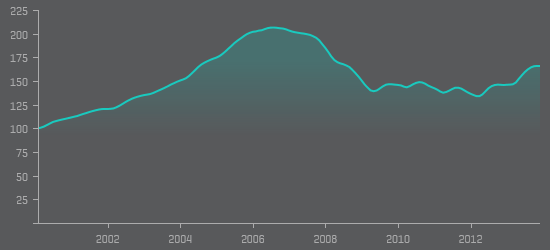
The chart above depicts the annual returns of the 20-City Composite Home Price Indicex. In November 2013, the 20-City Composites posted annual increase of 13.7%. Read more
Freddie Mac says in its January U.S. Economic and Housing Market Outlook that house-price gains will likely moderate from last year’s pace but rise about 5% in national indexes.
Economic News
First time claims for unemployment benefits totaled 348,000 in the most recent week. Initial claims had been seen rising by 2,000 to 328,000.
Fourth-quarter gross domestic product came in at 3.2 percent, compared with estimates of a reading of 3.3 percent and down from the prior reading of 4.1 percent.
Orders for long-lasting U.S. goods fell 4.3 percent in December. Economists had expected durable goods orders to rise 1.5 percent, compared to the prior month’s 3.4 percent surge.
December Personal Incomes were unchanged versus the 0.2% expected. Personal Spending rose 0.4%, above the 0.2% anticipated. The inflation reading Core PCE in December rose by 0.1%, inline, while year-over-year PCE rose by1.2%, up from 1.1% in November. Inflation is real cool – if this trend continues, we may just see the Fed step back in and take action – a la Japan – “to create” inflation.
The Chicago PMI in January fell to 59.6 from 60.8 recorded in December and had little impact on trading. Consumer Sentiment will be released at 10:00.
Sources: CNBC, Bloomberg, S&P Dow Jones, MMG, Housingwire


