Fed’s Break Bad – Rate’s Drop

Fed’s No Taper Talk Boosts Bonds & Lowers Mortgage Rates

An economy still stumbling toward recovery was not enough to sway the Federal Reserve, which defied market expectations Wednesday and said it will not begin pulling back on its monthly asset-purchasing program.

On Wednesday Bonds had the biggest one day rally since August of 2011, due to the Federal Reserve unexpectedly delayed tapering of its Bond purchase program as Fed Chairman Bernanke said that the economy still isn’t strong enough to begin easing back on QE III.  Many thought there would be a tapering announcement-but weak economic numbers and non-existent inflation will keep the Fed underwriting this economy recovery a while longer.

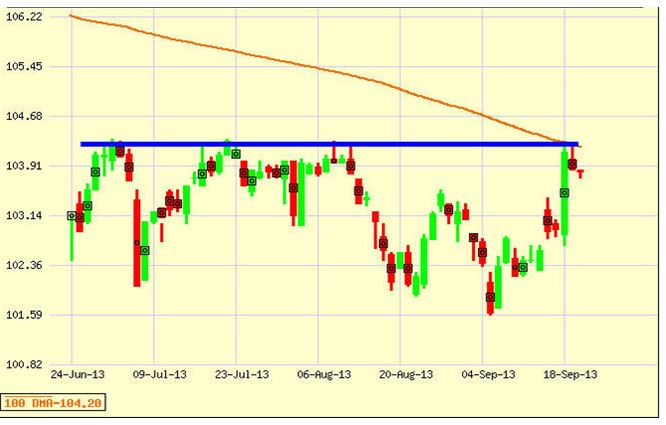
This is great news for Mortgage Rates, as Mortgage Bond prices surged to close at $104.09, up 118 basis points at the close on Wednesday and  Lenders responded by lowering Mortgage Rates by approximately .375% on 30 Year Fixed Rate loans.  I am recommending locking into Mortgage Rates for short term transactions (days to weeks) and floating longer term.

The Dow set a fresh high of 15,709.58 and the S&P 500 hit an intraday high of 1,729.44 on the news and bond yields moved sharply lower, with the benchmark 10-year note most recently at 2.76 percent.  However, Stocks gave back most of Wednesday’s gains after the Fed’s Bullard said there could be an October taper. But later in the day, Bullard said the Fed need not rush to taper while inflation is low. Another example of talking out of both sides of your mouth.

By weeks end The Dow lost 185.46 points to 15,451.09 the S&P 500 lost 12.43 to 1,709.91 while the Nasdaq dropped 14.65 points to end at 3,774.72. Oil was last seen at $104.70barrel after hitting almost $113 on August 28 at the height of the Syrian crisis.

Next week economic data heats up with readings on inflation, housing, U.S. growth along with Consumer Sentiment and Confidence. The Treasury will also be peddling a total of $97B in 2. 5 and 7-Year Notes.
Read more

The Chart below shows Wednesdays surge in Bond Prices.  Hence the recommendation to lock into rates, as its a long way back down, should the market reverse. Remember- Mortgage Rate’s move in the opposite direction of Bond prices.

Bond Chart Sep 2013


Market Moguls Comment on the Fed News

David Tepper, founder and president of Appaloosa Management, the Federal Reserve’s decision not to taper its $85-billion-a-month bond-buying program is a “pretty favorable environment for the markets.”

The Federal Reserve lost its chance for a “freebie” by deciding not to begin scaling back its $85-billion-a-month bond-buying program, Stanley Druckenmiller, founder of hedge fund Duquesne Capital.

Housing News

U.S. housing starts slipped to 891,000 in August, while building permits fell to 918,000. Economists had expected a rise in August housing starts to 915,000, up from 896,000 in the prior month. Building permits were forecast at 953,000, down slightly from 954,000 in the prior month.

Existing Home Sales rise by 1.7% from July to August to an annual rate of 5.48M units and above the 5.30M expected.

Economic News

Weekly claims for state unemployment benefits rose to 309,000. Economists polled by Thomson Reuters had expected initial claims to rise to 330,000.

The U.S. Consumer Price Index rose 0.1 percent in August. Economists polled by Thomson Reuters had expected consumer prices to rise 0.2 percent, the same rate of increase as the prior month.

U.S. industrial production rose 0.4 percent in August, matching economists’ expectations and following an unchanged reading in July.

Rates Drop on Mixed Job’s Report

The Mortgage Bankers Association reported that the average contract interest rate for a 30-year, fixed-rate mortgage with a conforming loan limit fell to 4.73% from 4.80% last week. The 30-year, FRM jumbo dipped to 4.71% from 4.78% .  The 15-year, FRM slipped to 3.75% from 3.84%, and the 5/1 ARM fell to 3.49% from 3.50%.

Short term consider locking, longer term floating. The 4% Mortgage Bond finished at 102.31, up 69bp and traded in an 81bp range, good for Rates.  The Dow finished the week down 14.98 points to 14,922.50, the S&P 500 was flat at 1,655.17 while the Nasdaq also finished near flat at 3,660.01. Oil
was last seen at $110.19/barrel up $1.82.

The Jobs numbers are out and forget what you hear on TV – this report stinks.  The lowest Labor Force Participation Rate in 35 years.  Big downward revisions erasing 74,000 jobs from what was previously reported in the last two months.  And 300,000 people disappeared from the Labor force.

The unemployment rate dropped to 7.3% – the lowest since Dec 2008…yeah!  However, the number is lower because of people leaving the labor force rather than organic job growth. 169,000 jobs were created versus the 177K expected.

Stocks moved higher because QE3 is rolling on and we don’t see any reason for it to stop or taper anytime soon.  Economic conditions are not on solid ground and the housing recovery is fragile.  We anticipate the Fed underwriting this recovery for quite a while longer.

Thursday the 10-Year Note hit 3%.  This from 1.61% on May 1st.  Mortgage Bonds traded to their worst levels in two years.  This market move was an exaggerated one and we think 3% yield on the 10-Year will serve as resistance against higher rates.

New Borrowers Feel the Pinch of Rising Rates

As rates and home prices start to rise, borrowers in top markets are finding themselves stretched thin as they make a move for homeownership. Read more

Housing News

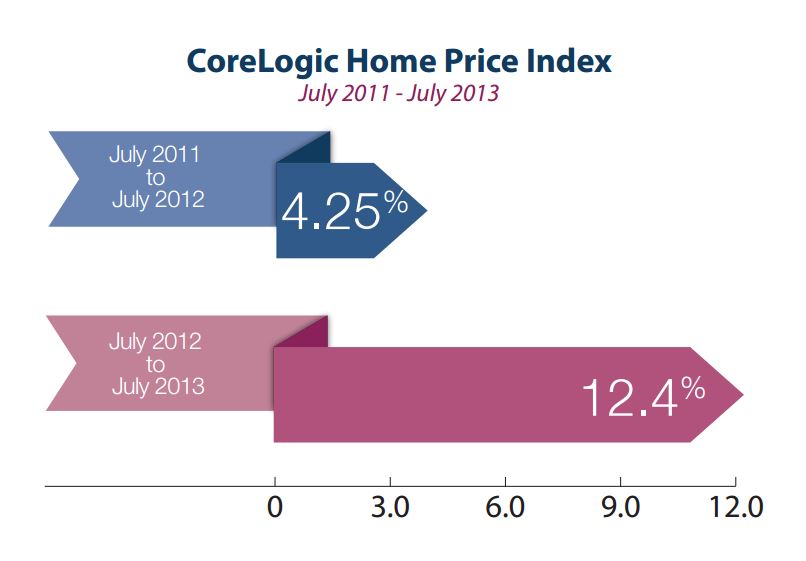
CoreLogic reported that home prices, including distressed sales, increased 12.4% nationwide in July 2013 compared to July 2012, which is the 17th consecutive monthly year-over-year increase in home prices. Overall, home prices remain 17.6% below the April 2006 peak, but have increased 22.8% from the post-crisis low in February 2012. The top five performers on the month were Chicago (48.7%), Phoenix (30.5%), Las Vegas (29.3%), Los Angeles (23.9%), and Boston (23.2%).

Sept Homes


Economic News

Upbeat Fed Outlook Suggests QE Tapering is Near

Conditions continued to improve in the U.S. over the past quarter, suggesting that the economy is reaching the point where monetary easing can be pulled back, according to the most recent assessment from the Federal Reserve. Read more

The U.S. Institute of Supply Management’s index rose to 55.7 in August. Economists polled by Reuters had expected the index of national factory activity to fall to 53.5 from 55.4 in July. (A reading above 50 indicates expansion in the sector.)

Construction spending in July rose 0.6 percent. Spending had been expected to increase 0.4 percent after a 0.6-percent drop in June.

Weekly claims for state unemployment benefits totaled 323,000. Economist had been expecting claims to total 330,000 compared to 331,000 the previous month.

Employers reported plans to cut payrolls by 50,462 in August, a 34 percent jump from the 37,701 planned job cuts announced in the previous month, according to a report from Challenger, Gray & Christmas


Sources: CNBC, MMG, Housingwire, Bloomberg

Rates Improve on Global Concerns

While mortgage rates have moved substantially higher on concerns of the central bank beginning to taper its monetary stimulus, issues in Syria had the adverse effect of pushing rates back down this week.

On Friday, the 4% fell by 16bp to end the session at 103.06 in light holiday trading. We recommend locking short term, longer term floating. Stocks got roughed up this month due to the taper talk and profit taking. For the month the Dow was down 4.1% to 1,4810.31, the S&P 500 lost 4.5% to 1,632.97 while the Nasdaq fell 2.3% to end the month at 3,589.86. Oil was last seen at $107.65/barrel down $1.15. Next week the big event will be Friday’s Non-farm payrolls report.
September has been historically bad for the Stock markets, but historical trends tend to take a backseat when artificial occurrences like Quantitative Easing (QE) are currently in place.  If Stocks were to correct, this could have a positive impact on Mortgage Bonds and home loan rates.

Freddie Mac reports that the average fixed rate for a 30-yr conventional mortgage is 4.51% and to obtain that rate, a potential borrower would have to pay 0.7 in points and fees.

US demands JPMorgan to pay over $6B to settle allegations that the banking giant missold securities to govt-backed mortgage companies (Fannie/Freddie) in run-up to financial crisis.

Housing News

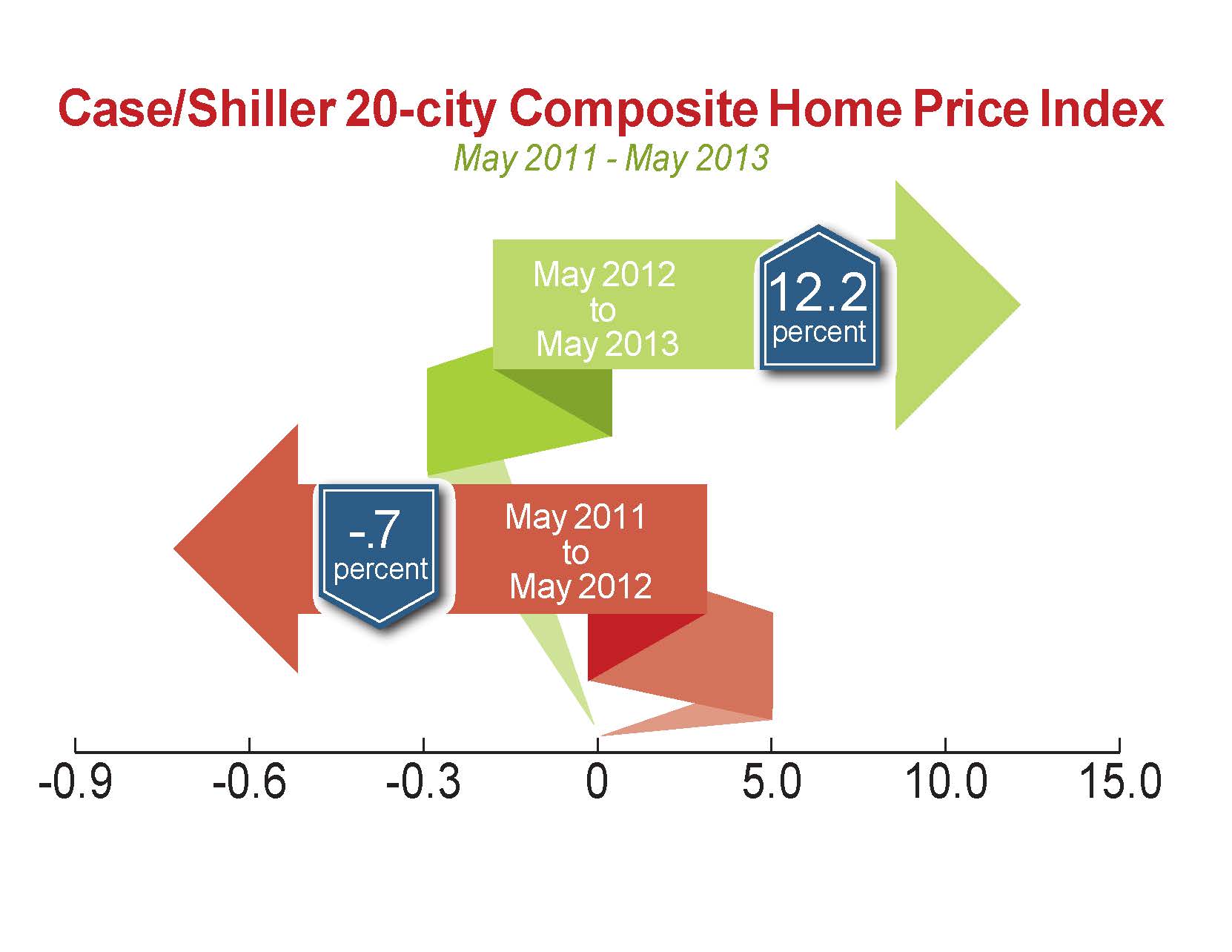
The Case/Shiller Home Price 20-city Index rises 12.1% from a year ago down from the May year-over-year number of 12.2%.

Signed contracts to buy existing homes faltered in July, as home buyers faced significantly higher interest rates along with rising home prices.   So-called “pending home sales” index from the National Association of Realtors fell 1.3  percent month-to-month but is 6.7 percent higher than July of 2012.  These contracts indicated lower closed home sales in August and September.

Foreclosures across the nation fell 25% from July 2012 to July 2013, as reported by Core Logic.

Economic News

Durable Orders or products lasting at least three years, plunged by -7.3% in July, below the -5.0% expected and down from the +3.9% registered in June.  It was the biggest drop since August 2012 with declines seen in computers, electronics and other equipment.

Consumer Confidence rises to 81.5 in August, up from the 80.3 registered in July and better than the 77.0 expected.

The U.S. Gross Domestic Product rose by 2.5 percent in the second quarter, up from 1.7 percent. Economists polled by Thomson Reuters had expected 2.2 percent.

Weekly Claims for State Unemployment Benefits fell to 331,000, compared with expectations of a drop to 332,000.

U.S. personal income and consumer spending both rose 0.1 percent in July. Economists in a consensus survey projected personal income to rise 0.1 percent, against a prior reading of 0.3 percent. Consumer spending was forecast to have risen 0.3 percent, versus the prior month’s 0.5 percent.

The Chicago PMI comes in at 53.0 for August, inline.

Consumer Sentiment at 82.1 in August, above the 80.0 expected.

Core PCE inflation indicator remains tame at 0.1% in July.


Sources: CNBC, Bloomberg, Housingwire, MMG


Rates Get Some Help

We recommend Floating/Not Locking Mortgage Rates at this time, as Bond Prices attempt to recover.  The 4% coupon rose by 56bp to end the session at 102.78.  Comments from Fed members on delaying QE taper past September coupled with weak data from New Home Sales gave Bonds a big lift on Friday. Lending some support to Bonds on Thursday was the jump in Weekly Initial Jobless Claims rising by 13K to 336K, inline with estimates.  The jobs data will be closely watched by the Fed in its decision on tapering.

St. Louis Fed President James Bullard told CNBC Friday that he didn’t think there was a need to hurry to cut back on the Fed’s bond-buying program. Read more

Stocks rose after getting beat up in the past two weeks – the Dow was up 46.77 points to 15,010.51, the S&P 500 was up 6.54 points to 1,663.50 while the Nasdaq rose by 19.08 points to end at 3,657.79. Oil was last seen at $106.34/barrel up $1.31.

Housing News

The Federal Housing Finance Agency reported that home prices rose 7.7% in the year ended in June as the housing recovery continues.  From May to June, prices rose by 0.7%.

Existing home sales


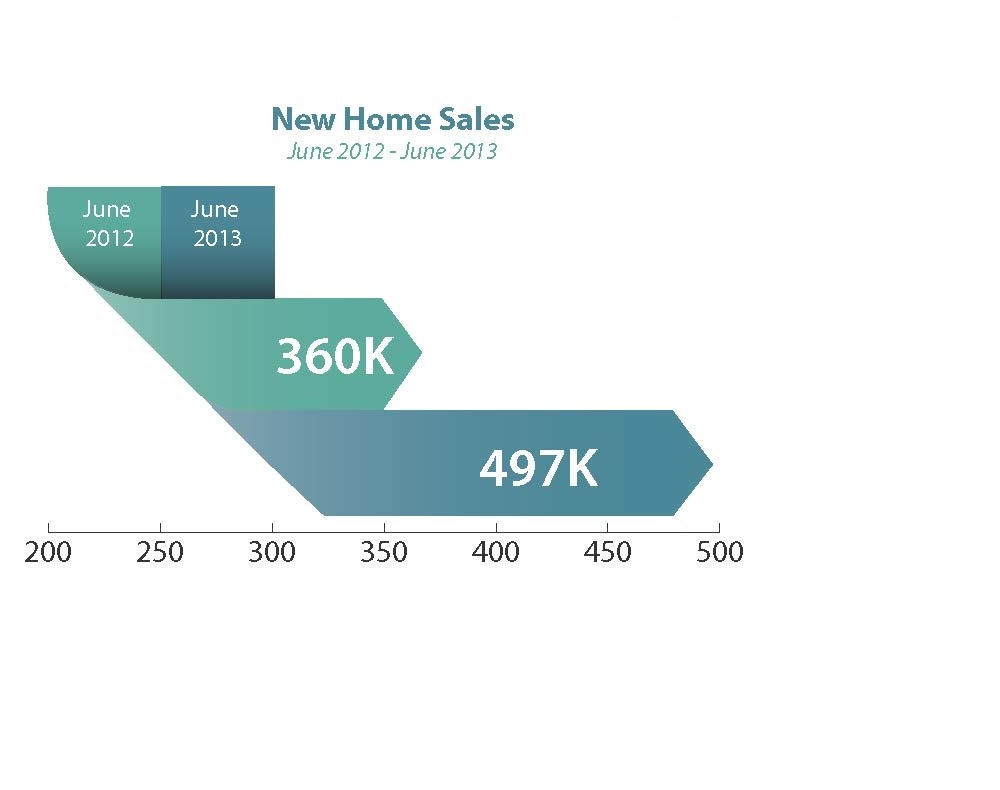
New Home Sales drop 13.4% in July from June to 394K units annualized and below the 485K expected. June’s numbers were revised lower to 455K from 497K.

Uncertainty binds U.S. Mortgage Finance System

While there’s no doubt a type of housing recovery is underway, analysts are at odds about the stability of the market, which is blocking private capital from making a comeback. On the reverse side, others feel housing is in full swing and the right policies are in play. Read more

Economic News

Initial Jobless Claims rising by 13K to 336K, inline with estimates.  It is the highest level in a month, but remain near post recession lows.  The 4-week average, which smoothes out seasonal abnormalities, fell by 2,250 to 330,500, near 6 year lows.

Mortgage Statistics

At the end of 2011, 8.2% of mortgages had at least 1-payment past due and another 4.4% of mortgages were in the foreclosure process.  At the end of 2012, 7.5% of mortgages were late and another 3.7% of mortgages were in foreclosure.  At the end of June 2013, 6.8% of mortgages were late and another 3.3% of mortgages were in foreclosure (source: Mortgage Bankers Association).


Sources: CNBC,Bloomberg, Housingwire, MMG

Rates Rise as Bonds Tank

Mortgage Bonds  plunged for the week on taper fears and positive economic data. The 3.5% fell 50bp to end at $99.06.  We recommend floating Mortgage Rates into next week.  Technically, the Bond is near the lower end of the recent trading range – this is good news as prices could bounce.  Couple this with Stocks on shaky ground, gives us cover to start the day Floating.  It would not surprise us to see Stocks continue to selloff after yesterday’s drubbing due to the Middle East uncertainty and weak retail earnings and guidance.  The Dow fell 30.72 to 15,081.47, the S&P lost 5.49 points to 1,655.83 while the Nasdaq fell 3.33 points to 3,602.77. Oil was last seen at $107.80/barrel up 49 cents.

Dennis Lockhart from the Atlanta Fed said yesterday that economic data remains too mixed for Fed voting members to lay out a clear plan for tapering at the next FOMC meeting.  Fed Chairman Bernanke has said that tapering may begin at the end of the year, but could be extended into the first quarter of 2014.

Housing News

Housing Recovery Continues to Heat Up

Despite all odds against the housing recovery, the market is steadily improving and housing experts do not expect the sector to lose its momentum any time soon.  Regardless of an inadequately housing supply, rising home prices reacting to strong demand and difficult lending environment, market expectations remain bullish on housing.  Nonetheless, housing is in its early stages of recovery and panelists at the Bipartisan Policy Center’s conference believe it’s not time for the Federal Reserve to take their foot off the bond-buying gas pedal just yet.  “There is a cyclical and structural nature to the problem,” explained Paul Weech of Housing Partnership Network.  He added, “We haven’t solved for the underlying structural problem and if we revert back to the norm, we still have millions of homes trying to get back in the full market recovery.” Read more  

Housing Starts rose by 5.9% from June to July to 896K units annualized, inline with estimates while Building Permits were up 2.7% to 943K, above the 934K expected.

Economic News

Weekly Initial Jobless Claims fell by 15K to 320K, a level not seen since October of 2007.  The 320K was below 339K expected.  There were no apparent seasonal distortions in the numbers. The jobs market has been improving and the Fed will be closely watching the numbers leading up to the mid-September FOMC meeting.

Inflation in July, as measured by the Consumer Price Index (CPI) and the Core CPI, both remained tame at 0.2%, inline with estimates.  On a year-over-year basis, CPI is at 2% while the Core is at 1.7% – both numbers within the Fed’s target.

Empire Manufacturing Index fell to 8.6 in August from the 9.4 registered in July but better than the 6.0 expected.  At 10:00am the Philly Fed and the NAHB Housing Market Index are set to be released.


Sources: CNBC,MMG, Housingwire,

Rates Holding Steady

Technically, Bonds continue to receive support from the 25-day Moving Average. Good news for Mortgage Rates.  With Stocks looking weak, we will continue to Float Mortgage Rates/Not locking.

The capital markets were very quiet  with low volumes on Friday. There were no economic reports. The 3.5% ended at 100.97 up 12bp and closed just near where it closed last Friday. Stocks continued to drop with 4 days of losses in five and had their worst weekend since June. The Dow fell 72.81 points to 15,425.51, the S&P 500 dropped 6.06 points to 1,691.42 while the Nasdaq finished the week at 3,660.10 down 9 points. Oil was last seen at $106.01/barrel up $2.62. 

Housing News

Representing a new post-bubble high, Las Vegas experienced a 31.2% jump in annual home prices in July, becoming the first metro to surpass 30% growth since the beginning of the recovery.

In the latest home data index released by Clear Capital, July home price trends continued to be strong both nationwide and when broken down between the nation’s four major regions.

Nationally, home prices grew 9.3% from last year, and were up 1.6% over the previous quarter. Interestingly enough, national home prices remained 33.4% below peak values, indicating the new norm for the nation’s housing.

“While July home prices continue to ramp up throughout the country led by Las Vegas posting more than 30% yearly growth, let’s not forget a healthy recovery means moderation as the new normal takes hold,“ said Alex Villacorta, vice president of research and analytics at Clear Capital. Read more

Economic News

Weekly claims for state unemployment insurance totaled 333,000 in the most recent week. Economists had expected claims to rise to 337,000, compared with 326,000 in the previous week.

U.S. self-reported daily consumer spending was $89 in July, little changed from the $90 reported in June and May, according to a poll by Gallup. The relatively flat spending levels of the past five months are consistent with the weak gross domestic product reports of the past three quarters, the polling company said.


Sources: MMG,CNBC,Housingwire, Bloomberg

Rates Benefit from Aug. Rally

Wishful thinking – but we have been calling for a Summer rally and have pointed out how Bonds rallied each of the past two years in the month of August. That theory received a tailwind on Wednesday, as the Fed talked down the economic recovery and confirmed that the Fed’s Bond buying program will continue for a while longer. Great news for Mortgage Rates as the Bond moved above it’s 25-Day Moving Average.

However, volatility was back on Thursday as a stronger than expected ISM Manufacturing Report and better than expected Initial Jobless Claims tanked Bonds. Then Bonds reversed higher again on Friday with the news of a weaker than expected Jobs Report.  Mortgage Rates, which move in the opposite direction of Bond Prices, went along for the ride as well.  Looking at the technical picture, Bond Prices and Mortgage Rates have improved significantly, as the move above the 25-Day Moving Average and a “Bullish Hammer” pattern which appeared in the chart on Thursday, may indicate the beginning of a Summer rally for Bond Prices and Lower Rates for Mortgage’s. We recommend floating, not locking Mortgage Rates at this time.

The Dow closed at 15,658.36 up 30.34 points, the S&P 500 was up 2.80 points to 1,709.67 while the Nasdaq was up 13.84 points to 3,689.59. Oil was last seen at $106.73/barrel down $1.16.

Freddie Mac reported Thursday that the 30-yr fixed rate conventional mortgage is at 4.39% when paying 0.7 in points and fees.

Steady Fed: Printing Presses to Keep on Rolling

Interest rates will hold near zero and the Federal Reserve will continue buying $85 billion in bonds every month while the economy continues to improve at a “modest” pace, the central bank said Wednesday.

Amid a backdrop of gradually improving economic data and concerns of asset price inflation, the Fed provided no further clues after its policy meeting this week that it will be easing back the throttle on easy money.

No changes are imminent to interest rates, but the $85 billion monthly money-printing program known as quantitative easing will be trimmed back only if the data points, particularly on unemployment, continue to improve.

“There is nothing in the latest FOMC statement released today to suggest that Fed officials have changed their minds about starting to taper the monthly asset purchases in September,” said Paul Ashworth, chief U.S. economist at Capital Economics. Read more

Housing News

Home Prices Rise Most Since 2006, Pace Cools – S&P Case/Shiller

U.S. single-family home prices rose in May, though the pace of gains cooled compared to the month before, a closely watched survey showed on Tuesday.

The S&P/Case Shiller composite index of 20 metropolitan areas gained 1 percent on a seasonally adjusted basis, shy of economists’ forecast for a 1.5 percent increase. That marked a slower pace from April’s 1.7 percent rise. Read more

Home Prices

Pending Home Sales Declined by 0.4% vs the -1.7% expected in June, down from the 6.7% registered in May as higher home loan rates put a crimp on sales. Pending Home Sales is a contract that has been signed, but that has not closed.

14,000 Home Sales Daily

That is the average number of homes that sell each and every day in this country according to the National Association of Realtors’ (NAR) latest Existing Home Sales Report. NAR reported that sales had increased 15.2% over the year before. According to the report, annualized sales now stand at 5.08 million. Divide that number by 365 (days in a year) and we can see that, on average, almost 14,000 homes sell every day.

Economic News

The Associated Press reports that four out of five U.S. adults experience poverty at some point during their lifetime.

Consumer Confidence for July declines to 80.3 from the 81.4 registered in in June and below the 81.6 expected.

U.S. Gross Domestic Product rose 1.7 percent in the second quarter. Economists in a Reuters survey forecast a 0.9 percent rise in GDP in the second quarter, compared to the previous quarter’s 1.8 percent gain.

The U.S. Economy Created 200,000 Jobs in July. Economists surveyed by Reuters had expected the report from ADP and Moody’s Analytics to show the private sector created 180,000 jobs in the month.

Weekly claims for state unemployment benefits fell to 326,000. Economists in a Reuters survey forecast that jobless claims would rise to 345,000 in the latest week, up 2,000 from the week prior.

The Institute for Supply Management reading for July rose to 55.4 from 50.9 the month before. Economists polled by Reuters were expecting the ISM reading to rise to 51.9. A separate report showed construction spending in June fell 0.6 percent. Construction spending had been forecast to rise 0.4 percent after a 0.5-percent increase the month before.

 The Jobs Report showed that employers added 162K new jobs in July, below the expected range of 175K – 224K.


Market Update


Mortgage Bonds were able to close above the 25-day Moving Average for two consecutive weeks – good sign for Mortgage Rates. However, Bond Prices still remain beneath the Falling Trend Line for Bond Prices. In order for Mortgage rates to fall, Bond prices need to close above the falling Trend Line.

Bond Prices rose by 9bp to end the session at 100.88, and above resistance  at the 25-day Moving Average for the second straight week. Stocks ended just slightly positive, after spending the majority of the day in the red. The Dow closed up 3.22 points to 15,558.83, the S&P 500 Index was up 1.40 points to 1,691.65 while the Nasdaq added 7.98 points to end the week at 3,613.16. Oil was last seen at $104.49/barrel down $1.00.

Looking ahead, next week will start off slow with just a few economic releases on Monday and Tuesday.  But – things really heat up come “hump day, as it will be Fed Day along with GDP and the ADP Report.  Then next Friday we receive the all-important Jobs Report.  Next week will likely determine whether the Fed starts tapering QE Unlimited in September.  If the numbers are soft – which we expect, we may just see QE3 roll on as is.

No matter what happens next week, we see the selling in Mortgage Bonds overcooked with prices ripe for a recovery.  Maybe next week will set the stage for an August Bond rally like we have seen each of the last two years. So the advise for now, is to Float and Not Lock Mortgage Rates at this time.

Government Regulations to Require 20% Down to Buy a Home

The recent Kiplinger Letter wrote –  The initial proposal, requiring borrowers to make a 20% down payment or banks to take the first 5% of loss on a securitized mortgage that winds up going bad, is under fire. Opponents say too many middle-class borrowers can’t muster 20% and banks can’t afford to risk a 5% loss, so the reg would severely crimp home buying.  The feds will back down a bit in the end. By mid-2014…a lower threshold for down payments and maybe less risk for banks that lend outside that parameter.

Housing News

New Home Sales Chart


Economic News

U.S. consumer sentiment rose in July to the highest level in six years as Americans felt better about the current economic climate, though they expected to see a slower rate of growth in the year ahead, a survey released on Friday showed. Read more

Weekly claims for state unemployment benefits totaled 343,000, versus the previous week’s total of 334,000. Economists polled by Thomson Reuters had expected 340,000 claims. In a separate report, orders for long-lasting goods were up 4.2%. Economists polled by Reuters had expected an increase of just 1.7%.

Durable Orders had an upside surprise surging by 4.2% in June, well above the 1.8% expected.  The Durables news has pushed Bonds into the red.


Sources: CNBC, Bloomberg, Kiplinger, MMG, Housingwire


*Disclaimers


Rates Rise as Bonds Collapse


Mortgage Bonds fell off a cliff Friday after the Labor Department reported that 195K jobs were created in June, well above the 166K expected while the April and May numbers were revised higher by 70K. In addition, hourly earnings rose by 0.4%, up from 0.0%, which can be viewed as inflationary. Mortgage Bond Prices fell 203bp to 98.88, pushing Mortgage Rates higher. Mortgage Bond players are hearing that consensus is calling for a September taper, which also influenced the move lower. Stocks finished on a high note – the Dow was up 147.29 to 15.135.84, the S&P 500 was up 16.48 points to 1,631.89 while the Nasdaq was up 35.71 points to end the week at 3,479.38. Oil was last seen at $103.63 up $1.98.  Bonds are severely oversold and are due for a bounce. Therefore, we recommend Floating Mortgage Rates, Not Locking and see if prices can stabilize.


Mortgage Rate Chart

Rising Mortgage Rates Boosted Pending Home Sales in May

Pending home sales increased 6.7%, month over month, in May to reach the highest level since late 2006, according to the National Association of Realtors’ (NAR) Pending Home Sales Index. That is an increase of 12.1% from May 2012. The jump was mostly a result of the fact that consumers were looking to lock in on favorable interest rates.

“Even with limited choices, it appears some of the rise in contract signings could be from buyers wanting to take advantage of current affordability conditions before mortgage interest rates move higher,” said Lawrence Yun, NAR chief economist, in a statement. “This implies a continuation of double-digit price increases from a year earlier, with a strong push from pent-up demand.” Mortgage rates surged to the highest level in almost two years last week after the Federal Reserve announced a plan to wind down its stimulus program by mid-2014. The announcement incited a sell-off in the bond market that drove rates even higher.

In addition, home prices keep rising. The national median home price is forecast to spike by more than 10% to nearly $195,000 by the end of this year, Yun said. This would be the strongest increase since 2005, when the median increased 12.4%.  Existing-home sales are forecast to increase 8.5% to 9%, reaching about 5.07 million in 2013, the highest in seven years. This would be slightly above the 5.03 million total recorded in 2007.

CoreLogic reported that home prices, including distressed sales, rose by 12.2% in May 2013 compared to May 2012, the biggest annual gain since February 2006.  Excluding distressed sales, prices increased by 11.6% year-over-year.  From April to May, prices rose by 2.6% including distressed sales, excluding prices rose by 2.3%.  However, prices are 20.4% below the peak set back in April 2006.  Tight inventories and historically attractive home loan rates have been the fuel behind the rise.   CoreLogic went on to say that prices are expected to rise by 13.2% from June 2013 to June 2014 and see a monthly rise nearly 3% from May to June.

Bank America Home Appraisals being Reviewed in India?

Wow! How would you feel if the appraisal for your home loan was sent to India to be reviewed?  Probably not so good.  It’s bad enough appraisals are done through central management companies that are outside of the State in which the property is located.  But now, Bank of America will be sending Appraisals to be reviewed outside of our country, to India.  Yeah, that makes a lot of sense.

Economic News

The June ISM index was reported at 50.9 and the employment component of the index was below 50, shows the economy barely expanding.


Jobs report– The U.S. economy created 195,000 new non-farm payroll jobs in June, the Labor Department reported, after an upwardly revised 195,000 jobs were created in May. The unemployment rate was unchanged at 7.6 percent as more people entered the labor market.  To put the current jobs environment in perspective, in 2009, at the height of the recession, there was an average of 421,000 jobs lost each month.  So far this year, employers added an average of 189K workers each month.


Sources: CNBC, Bloomberg, MMG, Housingwire, MortgageOrb

Home Loan Rates Under Pressure

We are currently recommending Floating Mortgage Rates headed into the weekend as Bonds close near the highs.

Mortgage Rates had another crazy week, with intraday swings of one quarter to one half of a percent.  Rates changed several times during each day of the past week.  However, there are low rate opportunities; you just have to be able to lock the rate at that very moment and that’s difficult to do in this type of market.  So, make sure you have your paperwork in so you can lock in when the time is right.

On Thursday, Mortgage Bonds continued to stabilize and move higher which moved Mortgage Rates lower, on dovish QE talk from several Fed members and also due to noted fund manager Jeffrey Gundlach saying he was bullish on the sector.

Mortgage Bonds managed to close near unchanged after a big drop earlier in the session closing at 101.47 up 3bp.
The Dow dropped 114.89 to 14,909.60, the S&P 500 fell by 6.92 points to 1,606.28 while the Nasdaq closed near unchanged at 3,403.25. For the quarter the Dow gained 2.2%, the S&P rose 2.3% and the Nasdaq was up 4.2%. Oil was last seen at $96.48/barrel down 58 cents. Next week is holiday shortened – the Bond markets will close early at 2:00pm ET on Wednesday and Stocks will close at 1:00pm. All capital markets will be closed on Thursday for 4th of July. Non-farm payrolls will be
released on Friday morning and it is expected that employers added 165K new jobs in June.

Economic Data confirmed the Fed will be active buyer of Bonds for a while, good for Mortgage Rates, as the Core Personal Consumption Expenditures (PCE) rose by just 0.1%, inline with estimates while year-over-year Core PCE was a scant 1.1%, well below the Fed’s upper end range of 2%.


Mortgage Rates Skyrocket on Fed Fears

FRED Graph

Mortgage Rates Rose last week on fears of less Fed intervention in the mortgage-bond market.

“Interest rates moved up sharply following the Federal Reserve press conference last Wednesday, June 19th, where it was indicated that the Fed could begin tapering their asset purchases later this year,” said Mike Fratantoni, MBA’s vice president of research and economics.

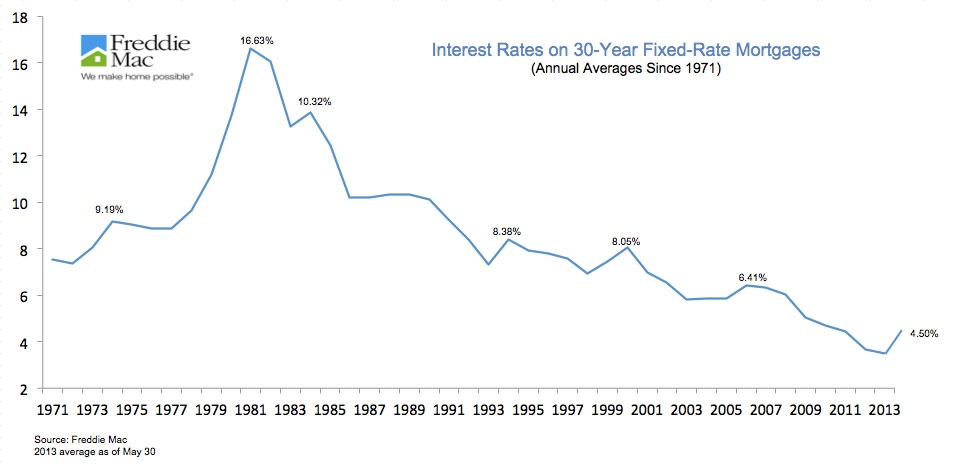
The 4.46% Fixed home loan rate that carries an additional 0.8 point/fees is up from 3.93% in the previous week. It was the largest weekly increase since 1987 and the highest it’s been since August 2011.

Fed In Overdrive Trying to Curb Rising Mortgage Rates

After this month’s Federal Open Market Committee minutes reached the public, the market took a hefty kick and mortgage rates surged higher.  As a result, the Federal Reserve intensified its efforts to curb a growth-threatening rise in long-term interest rates, Bloomberg reports.

“It is pretty obvious that the Fed was caught off guard by the market’s reaction given the lengths to which they have gone to reshape market expectations,” Drew Matus, deputy U.S. chief economist at UBS Securities, said. “The range of both speakers and outlets suggests that these comments are, if not coordinated, then at least part of a collective — likely futile — effort to re-mold the market’s view of the June FOMC press conference.”  Read the full story

Spiking Mortgage Rates Even with their recent rise, mortgage rates are still “incredibly low” by historical standards, so they will not halt the housing recovery, Trulia Chief Economist Jed Kolko told CNBC on Tuesday. Full Story

Tight Credit Is Slowing Housing Recovery

Tight credit, particularly for young people, is hindering the housing recovery, according to research published at the Joint Center For Housing Studies at Harvard University.
According to the State of the Nation’s Housing 2013 report, the recession has significantly boosted the rental market in the past several years. In 2012, the number of renter households in the U.S. increased by 1.1 million, and construction of new multifamily units increased at a double-digit rate.
However, this has come at the expense of the housing market.
Meanwhile, interest rates and home prices, although now on the rise, have hit historic lows, the unemployment rate is improving, inflation has stabilized, and the country’s economic picture has improved overall.

So why are so many young people still opting to rent?
As the study reveals, banks have tightened their lending standards, which in turn is preventing young people from buying homes. People age 25 – 54 saw their homeownership rates reach the lowest point in 2012 (record keeping began in 1976), according to the report.
“Tight credit is limiting the ability of would-be home buyers to take advantage of today’s affordable conditions and likely discouraging many from even trying,” says Chris Herbert, director of research at the Joint Center for Housing Studies. “At issue is whether, and at what cost, mortgage financing will be available to borrowers across a broad spectrum of incomes, wealth and credit histories moving forward.”

Currently, more than 20.6 million households are spending more than half of their household income on housing, the report finds. And with so many homeowners struggling just to keep their homes, it could be that many younger people simply do not want to face the burden of having a mortgage.
Considering current economic conditions, the need for a strong rental market remains important, the research finds. However, federal budget sequestration will pare down the number of households receiving rental housing assistance.
“Given the profoundly positive impact that decent and affordable housing can have on the lives of individuals, families and entire communities, efforts to address these urgent concerns as well as longstanding housing affordability challenges should be among the nation’s highest priorities,” says Eric S. Belsky, managing director of the Joint Center for Housing Studies.

Housing News

Home Prices took a major leap in April, setting a new monthly record for gains.  From March to April, home price gained 2.6 percent and 2.5 percent for the top 10 and top 20 U.S. markets, respectively, according to the latest S&P/Case-Shiller Home Price Indices.  Average prices rose 11.6 percent and 12.1 percent in April from a year ago.

New Home Sales jumped to 476,000 in May, much higher than the 462,000 that analysts expected, according to the Commerce Department.  Compared with May 2012, sales were up 29 percent.  Home sales data will be closely watched in the coming months for signs of strain from the rise in mortgage rates.  The housing market recovery, which is helping to soften the blow on the economy from tight fiscal policy, has been largely driven by record-low mortgage rates, thanks to the Federal Reserve’s generous monetary stimulus.

Pending Home Sales rise by 6.7%, above the 1.5% expected.

Spiking Mortgage Rates Even with their recent rise, mortgage rates are still “incredibly low” by historical standards, so they will not halt the housing recovery, Trulia Chief Economist
Jed Kolko told CNBC on Tuesday. Full Story

Economic News

U.S. orders for long-lasting goods rose a better-than-expected 3.6 percent in May, compared to a 3.5 percent increase the prior month. Economists polled by Reuters had expected goods orders to rise by 3.0 percent.

US consumer confidence rose to the highest level since January 2008.

First quarter Gross Domestic Product (GDP), came in at 1.8% versus expectations of 2.4%.  The drop was attributed towards lower consumer spending and an pullback in business investment.

Weekly Jobless Claims fell 9,000 last week to a seasonally adjusted 346,000, according to the Labor Department, largely in line with expectations. The four-week moving average for new claims fell 2,750 to 345,750.

Consumer Spending rebounded 0.3 percent in May, matching estimates, after a revised 0.3 percent decline in the prior month, according to the Commerce Department.

Core Personal Consumption Expenditures (PCE) rose by just 0.1%, inline with estimates while year-over-year Core PCE was a scant 1.1%, well below the Fed’s upper end range of 2%.

Personal Spending rose by 0.3% in May after a 0.3% decline and was just below the 0.4% expected.  Personal Incomes jumped by 0.5% versus the 0.2% anticipated.

The Personal Savings rate moved up to 3.2% from 3%

Consumer Sentiment at 84.1, above the 82.7 expected and up from the initial May reading of 82.7.

Chicago PMI falls to 51.6 in June from the My reading of 58.7 and below the 55.5 expected.


Sources: CNBC, Housingwire, MMG, Bloomberg, Mortgageorb