Jobs, Jobs, Jobs

Technically, the benchmark 3.5% Bond is trading just below resistance at the  25-day Moving Average and near the upper end of the year’s trading range.  We  will continue to carefully float, not lock mortgage rates at this time.

Weekly Survey of Rates from the Mortgage Bankers Association

For the week of June 4th, 2014 

The average contract interest rate for 30-year fixed-rate mortgages with conforming loan balances ($417,000 or less) decreased to 4.26 percent from 4.31 percent, with points decreasing to 0.13 from  0.15 (including the origination fee) for 80 percent loan-to-value ratio (LTV) loans.

The average contract interest rate for 30-year fixed-rate mortgages with jumbo loan balances (greater than $417,000) decreased to 4.22 percent from 4.23 percent, with points decreasing to 0.11 from 0.16 (including the origination fee) for 80 percent LTV loans.

The average contract interest rate for 15-year fixed-rate mortgages decreased to 3.39 percent from 3.42 percent, with points         increasing to 0.07 from 0.06 (including the origination fee) for 80 percent LTV loans. The effective rate decreased from last week.

Commercial Real Estate Lending

Commercial Mortgage backed Securities (CMBS)– The 10 Yr Swap rate moved lower to finish the week at 2.665%,  up from last weeks 2.541%.

Housing News

You can’t sell what you don’t have

Some housing experts are concerned that the housing recovery seems to be stalling. Some are blaming the one percent increase in mortgage interest rates since the first quarter of last year. Others are pointing at an economy that is improving but only at a snail’s pace. Still, others are questioning whether homeownership is even considered by some to still be part of the American Dream.

However, there is great evidence that the true reason home sales aren’t stronger is because we lack inventory in the vast majority of markets across the country.

Here are a few reasons why we believe this to be true:

Buyers Are Searching the Internet for Homes in Record Numbers

Trulia, a major online residential real estate site for home buyers that lists properties for sale, recently reported that it is experiencing record levels of traffic as the spring buying season kicks into high gear. The site reached a record number of unique visitors in April with nearly 50 million.

Buyers Are Physically Out Shopping

The number of potential home buyers physically looking at homes is increasing. The National Association of Realtors (NAR) measures this each month in a data point they call “foot traffic”. Foot traffic measures the number of homes being shown by agents. That number has increased for each of the last three months and has doubled over that period of time.

Inventory Levels are BELOW Historic Norms

History shows us that a balanced real estate market requires a six month supply of available housing inventory. We have not reached that mark in over two years. Though inventory numbers are improving, the recent increase in buyers now looking will again put a strain on this number.

Bottom Line

While inventory levels remain below historic norms, it will remain a seller’s market. This being the case, if you are considering selling your home, now may be the time to list it for sale.

Economic News 

Steady as she goes: Job creation keeps up pace

Nonfarm payrolls grew at a pace in line with recent trends, rising 217,000 in May as the unemployment rate held steady at 6.3 percent, according to numbers released Friday by the Bureau of Labor Statistics.

Most of the job gains came on lower-paying industries as wages rose modestly, increasing 5 cents an hour to maintain the 2.1 percent growth over the past 12 months. Average hours worked came in flat at 34.5.

A broader measure of joblessness that includes those working part time for economic reasons and those who have quit looking remained elevated at 12.2 percent, though that was a low for the year and the best “U6” measure since October 2008.

Economists surveyed by Reuters expected 218,000 U.S. jobs were created last month, down from April’s downwardly revised 282,000. The unemployment rate had been expected at 6.4 percent. Read more

JobsUS jobless claims rise as payrolls data loom

The number of Americans filing new claims for unemployment benefits rose last week, but the underlying trend continued to point to a firming labor market.

Initial claims for state unemployment benefits increased 8,000 to a seasonally adjusted 312,000 for the week ended May 31, the Labor Department said on Thursday. Read more


The Feds Quantitative Easing Time Line

Quantitative Easing


The U.S. manufacturing sector expanded in May at a faster clip than previously seen, an industry report showed on Monday.

Financial data firm Markit said its final U.S. Manufacturing Purchasing Mangers Index rose to 56.4 in May from 55.4 in April, and following a preliminary reading of 56.2. A reading greater than 50 indicates expansion.


Sources: CNBC, Bloomberg, Reuters, KCM, MMG, Housingwire


Home Prices Up 0.9% – Rates Move Lower

Mortgage Rates moved lower as Mortgage Bonds moved higher, with encouraging technical signs. We will float, not lock into Mortgage Rates into the weekend. However, if you’re closing soon, then lock.

Mortgage Bonds finished at 105.91 up 9bp. The S&P closed at another record high – 1,923.57 up 3.54 points. The Dow finished at 16,717.17 up 18.43 points, Nasdaq lower by 5.32 points to 4,242.61. Oil was last seen at $102.86/barrel down 72 cents. Next week’s economic calendar is full and ends with a bang on Friday with the May Jobs Report. Look for the switch to the 3.5% coupon as the main Bond late Monday.

Weekly Survey of Rates from the Mortgage Bankers Association

For the week of May 28, 2014 

The average contract interest rate for 30-year fixed-rate mortgages with conforming loan balances ($417,000 or less) decreased to 4.31 percent, the lowest level since June 2013, from 4.33 percent, with points decreasing to 0.15 from  0.20 (including the origination fee) for 80 percent loan-to-value ratio (LTV) loans.  The effective rate decreased from last week.

The average contract interest rate for 30-year fixed-rate mortgages with jumbo loan balances (greater than $417,000) decreased         to 4.23 percent, the lowest level since June 2013, from 4.24 percent, with points increasing to 0.16 from 0.09 (including the origination fee) for 80 percent LTV loans.

The average contract interest rate for 15-year fixed-rate mortgages decreased to 3.42 percent, the lowest level since October 2013, from 3.43 percent, with points decreasing to 0.06 from 0.15 (including the origination fee) for 80 percent LTV loans.

Commercial Real Estate Lending

Commercial Mortgage backed Securities (CMBS)– The 10 Yr Swap rate moved lower to finish the week at 2.541%, down from last weeks 2.619%.

Housing News

US 20-city home prices up 0.9% in March vs 0.7% est: S&P/Case-Shiller

U.S. single-family home prices rose in March, a closely watched survey said Tuesday, as the housing market extended its fragile recovery.  The S&P/Case-Shiller composite index of 20 metropolitan areas rose 0.9 percent in March on a seasonally adjusted basis, up from the prior month’s gain of 0.8 percent. A Reuters poll of economists had forecast a 0.7 percent rise.

Year over year, the index jumped 12.4 percent, S&P/Case-Shiller said, a slightly slower rate than February’s 12.9 percent surge but well above Wall Street’s estimates.

Yet not all the news was encouraging. David Blitzer, chairman of the index committee at S&P, said that the report suggested price gains are moderating. Additionally, key markets such as Las Vegas, Los Angeles, Phoenix and San Francisco are showing “substantial slowdowns,” he added. Read more

Housing Index


Pending home sales up just 0.4% in April, missing expectations

Warmer weather and higher expectations failed to cause a meaningful surge in home sales.

Signed contracts to buy existing homes increased just 0.4 percent in April, according to a monthly report from the National Association of Realtors (NAR). The expectation had been for at least a two percent gain sequentially.

The Realtors’ so-called pending home sales index is now 9.2 percent lower than April of 2013.

“Higher inventory levels are giving buyers more choices, and a slight decline in mortgage interest rates this spring is raising prospective home buyers’ confidence,” said Lawrence Yun, chief economist for the NAR. “An uptrend in closed sales is expected, although some months will encounter a modest setback.” Read more

The Top 10 Markets for Luxury Homes 

10. Long Island, N.Y.:

The price to purchase home: $2,200,000, Average monthly mortgage payment: $8,787

9. Boston, Mass.:

The price to purchase home: $2,313,000, Average monthly mortgage payment: $9,239

8. Ventura, Calif.:

The price to purchase home: $2,400,000, Average monthly mortgage payment: $9,586

7. San Diego, Calif.:

The price to purchase home: $2,400,000, Average monthly mortgage payment: $9,586

6. West Palm Beach, Fla.:

The price to purchase home: $2,466,000, Average monthly mortgage payment: $9,850

5. Miami:

The price to purchase home: $2,900,000, Average monthly mortgage payment: $11,583

4. San Jose, Calif.:

The price to purchase home: $3,380,000, Average monthly mortgage payment: $13,501

3. Orange County, Calif.:

The price to purchase home: $3,450,000, Average monthly mortgage payment: $13,780

2. Los Angeles:

The price to purchase home: $3,650,000, Average monthly mortgage payment: $14,579

1. San Francisco:

The price to purchase home: $5,350,000, Average monthly mortgage payment: $21,369


Economic News

Durable goods orders jump, but capital spending sags in April

Orders for long-lasting U.S. manufactured goods unexpectedly rose in April, but a drop in a measure of business capital spending plans could temper expectations for a sharp rebound in economic growth this quarter.

The Commerce Department said on Tuesday durable goods orders increased 0.8 percent as demand for defense capital goods surged and orders for fabricated metal products, transportation equipment and electrical equipment, appliances and components rose. Read more

US consumer confidence at 83.0 in May, matching expectations

Economists in a consensus survey expected The Conference Board’s gauge of U.S. consumer confidence to rise to 83 in May from 82.3 in the prior month.

The U.S. gross domestic product contracted by 1.0 percent in the first quarter. Economists had expected first-quarter GDP to show a contraction of 0.4 percent.

Weekly claims for state unemployment benefits came in at 300,000, compared with expectations of a drop to 326,000.

Consumer sentiment hits 81.9 in May, vs. 82.4 estimate.


Sources: Bloomberg, CNBC, Housingwire, MMG, Reuters, MBA

Home Sales Up- Rates Down


Mortgage Rates have revisited lows not seen since May 2013. We will continue to recommend floating/not locking rates headed into the weekend.
Mortgage Bonds drifted higher in the shortened session, shrugging off a better than expected New Home Sales. The 4% closed at 105.56, up 3bp. Stocks close at 4pm and are currently holding decent gains. All capital markets will be closed on Monday in observance of Memorial Day.

Weekly Survey of Rates from the Mortgage Bankers Association

For the week of May 21, 2014 

The average contract interest rate for 30-year fixed-rate mortgages with conforming loan balances ($417,000 or less) decreased to 4.33 percent, the lowest rate since November 2013, from 4.39 percent, with points decreasing to 0.20 from  0.22 (including the origination fee) for 80 percent loan-to-value ratio (LTV) loans.

The average contract interest rate for 30-year fixed-rate mortgages with jumbo loan balances (greater than $417,000) decreased to 4.24 percent, the lowest rate since May 2013, from 4.29 percent, with points decreasing to 0.1 from 0.16 (including the origination fee) for 80 percent LTV loans.

The average contract interest rate for 15-year fixed-rate mortgages decreased to 3.43 percent, the lowest rate since October 2013, from 3.48 percent, with points increasing to 0.15 from 0.12 (including the origination fee) for 80 percent LTV loans.

Commercial Real Estate Lending

Commercial Mortgage backed Securities (CMBS)– The 10 Yr Swap rate moved lower to finish the week at 2.619 2.586%, up from last weeks 2.586%.

Housing News

New home sales hit 433,000 in April

Economists in a consensus survey expected new home sales to rise to 420,000 in April, up from the prior month’s reading of 380,000.

Sales of new U.S. single-family homes rose more than expected in April and the stock of houses on the market hit a 3-1/2 year-high, further signs the sputtering housing recovery was poised to regain steam.  The Commerce Department said on Friday sales increased 6.4 percent to a seasonally adjusted annual rate of 433,000 units, ending two straight months of declines.  March’s sales pace was revised up to 407,000 units from a previously reported 384,000 units. Read more

Existing home sales rise 1.3% to 4.65M rate in April

U.S. home resales rose in April and the supply of properties on the market increased, suggesting the housing market was regaining its footing.  The National Association of Realtors said on Thursday existing home sales increased 1.3 percent to an annual rate of 4.65 million units, marking the second increase in sales in nine months. Read more

home sales


Economic News

US jobless claims surge unexpectedly, back above 300,000

The number of Americans filing new claims for unemployment benefits rose last week but stayed close to a seven-year low and pointed to ongoing healing in the labor market. Initial claims for state unemployment benefits rose 28,000 to 326,000 for the week ended May 17, the Labor Department said on Thursday.

The prior week saw the lowest reading since May 2007 and brought claims back to a level last seen before the deep 2007-09 recession. Economists say the cumulative reduction in new claims could point to stronger hiring, although one metric in Thursday’s report cast a shadow over the upcoming monthly employment report for May. Read more

Fed’s Kocherlakota: Below-target inflation signals significant economic problem

A below-target inflation rate signals a significant economic problem, Minneapolis Fed president Narayana Kocherlakota said on Wednesday.  Kocherlakota, a voting member of the Fed’s Open Market Committee, suggested the Fed could target an inflation rate above 2 percent to make up for the recent shortfall.  His comments come just minutes before the closely watched minutes of the last Fed meeting are released.  Last month Kocherlakota warned that his colleagues were letting the economy waste “lots of resources” by leaving inflation too low and unemployment too high. Read more


Sources: CNBC, Bloomberg, Reuters, Housingwire, MMG


Slow Economic Growth

The current trend direction for Mortgage Rates is Sideways to lower as Bond prices are at $105.31 after a volatile week. Therefore, we recommend floating, not locking into rates at this time.

Stocks were near unchanged, but were much lower  before the housing data was released.  The closely watched S&P 500 traded under  its 50-day Moving Average yesterday, but did manage to close above that level.   The fear index, or the VIX, had its biggest one day bounce in a month. The  higher the VIX, the more fear there is in the equity markets, especially with  prices near all-time highs. Yesterday, Hedge fund titan, David Tepper of  Appaloosa Management, said that he is nervous with Stock markets due to economic  growth prospects.  He said even adjusting for weather, the economy looks to be  growing more slowly than expected – we agree and to further that point, we have  not seen real economic expansion during this entire recovery.

Financing

Weekly Survey of Rates from the Mortgage Bankers Association

For the week of May 14, 2014 

The average contract interest rate for 30-year fixed-rate mortgages with conforming loan balances ($417,000 or less) decreased to 4.39 percent, the lowest rate since November 2013, from 4.43 percent, with points increasing to 0.22 from  0.21 (including the origination fee) for 80 percent loan-to-value ratio (LTV) loans.

The average contract interest rate for 30-year fixed-rate mortgages with jumbo loan balances (greater than $417,000) remained unchanged at 4.29 percent, with points increasing to 0.16 from 0.14 (including the origination fee) for 80 percent LTV loans.

The average contract interest rate for 15-year fixed-rate mortgages decreased to 3.48 percent, the lowest rate since November 2013, from 3.52 percent, with points decreasing to 0.12 from 0.22 (including the origination fee) for 80 percent LTV loans.

Commercial Real Estate Lending

Commercial Mortgage backed Securities (CMBS)– The 10 Yr Swap rate moved lower to finish the week at 2.586%, down from last weeks 2.659%.

Housing News

U.S. housing starts totaled 1.072 million in April. Economists had expected housing starts to rise to 980,000 in April, up from the prior month’s 950,000. Read more

Home builders losing confidence in recovery

After three months of holding out steady hope, sentiment among U.S. home builders weakened slightly in May. A monthly index from the National Association of Home Builders slipped one point from a downwardly revised April figure. The index now stands at 45. Anything above 50 is considered positive sentiment. Read more

Economic News

U.S. retail sales rose 0.1 percent in April. Economists had expected headline retail sales to rise by 0.4 percent, slower than the prior month’s 1.1 percent gain.

U.S. import prices fell 0.4 percent. Import prices had been forecast up 0.4 percent in April, versus 0.6 percent in the month prior.

U.S. producer prices increased 0.6 percent in April. Economists had expected producer prices to rise by 0.2 percent, slightly less than the prior month’s 0.5 percent gain.

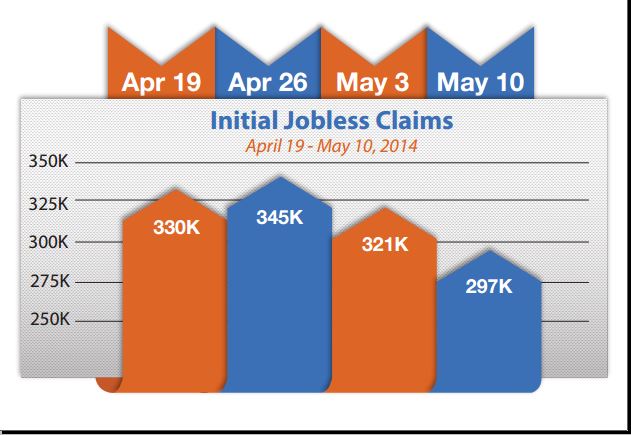
First-time claims for state unemployment benefits totaled 297,000 in the most recent week. Economists had expected initial claims to dip to 320,000. In a separate report, April consumer prices increased 0.3 percent, in line with estimates and compared with the prior month’s 0.2 percent gain.

Jobs Chart


Sources: CNBC, Bloomberg, Housingwire, MMG

Half of Connecticutians want to get the hell out

We continue to recommend short term locking mortgage rates, measured in a few days to a few weeks.
Mortgage Rates remained relatively stable as Bonds finished the week down 12 basis points after revisiting October’s highs. The good news is rates have improved quite a bit since December.
Stocks saw meager gains – the Dow closed at 16,583.34 up 32.37 points, the Nasdaq gained 20.37 points to 4,071.86, while the S&P 500 closed at 1,878.48 up 2.85 points. Both the Nasdaq and the S&P closed with weekly losses. Oil was last seen at $100.08/barrel near unchanged.

Housing News

Half of people living in Connecticut and Illinois want to get the hell out

New data is out on the states people want to leave, and it’s tailor-made to troll all your Facebook friends from Illinois and the northeastern Amtrak corridor.

Gallup asked people around the country whether they would move away from their states, given the chance. As it turns out, half of Illinois residents and 49 percent of all Connecticutians (Connecticutese? Connecticuters?) want to change states. In addition, it looks like a good chunk of the northeastern seaboard is just itching to pack up a U-Haul. Read more

CoreLogic reported on Tuesday that home prices, including distressed sales, rose by 11.13% year-over-year in March, while prices were up 1.4% from February to March.  The 11.13% year-over-year increase is down from the 11.81% registered in the year ended in February.  The big gains seen in 2014 will most likely not be sustained and hopefully prices will continue to decrease a bit to get back down to more affordable levels.

Home Prices


Cash is King

Cash sales of residential home properties made up nearly 43% of total sales in the first quarter of 2014 due in part to wealthy individuals, empty nesters downsizing and institutional investors.  That is up from 19% in the first quarter of 2013.


Cash Buyers


Financing

Weekly Survey of Rates from the Mortgage Bankers Association

For the week of May 7, 2014 

“It is official: we are in a majority purchase market for the first time since 2009,” said Mike Fratantoni, MBA’s Chief Economist. “A sizeable increase in purchase applications last week likely reflected the impact of somewhat lower mortgage rates as well as continued growth in the job market, as confirmed by Friday’s employment report from the BLS.  Despite the strong increase in the purchase market last week, volume continues to run 16 percent behind last year’s pace.”

The average contract interest rate for 30-year fixed-rate mortgages with conforming loan balances ($417,000 or less) decreased to 4.43 percent, the lowest rates since November 2013, from 4.49 percent, with points decreasing to 0.21 from  0.38 (including the origination fee) for 80 percent loan-to-value ratio (LTV) loans.

The average contract interest rate for 30-year fixed-rate mortgages with jumbo loan balances (greater than $417,000) decreased to 4.29 percent, the lowest rate since June 2013, from 4.37 percent, with points remaining unchanged at 0.14 (including the origination fee) for 80 percent LTV loans.

The average contract interest rate for 15-year fixed-rate mortgages decreased to 3.52 percent from 3.53 percent, with points decreasing to 0.22 from 0.31 (including the origination fee) for 80 percent LTV loans.

Commercial Real Estate Lending

Commercial Mortgage backed Securities (CMBS)– The 10 Yr Swap rate moved lower to finish the week at 2.659%, down from last weeks 2.766.

Economic News

The Organization for Economic Cooperation and Development reports that economic activity is projected to pick up once the effects of severe winter weather dissipate.  Economic activity is projected to pick up in 2014 once the effects of severe winter weather dissipate. Given ample corporate cash flow and an improved demand outlook, business investment should accelerate significantly. Sizable gains in asset prices have boosted household wealth, which, combined with steady progress on the labour market, should provide support to private consumption and residential investment.

Fiscal contraction is creating less of a drag on economic growth, although further consolidation at a slower pace will be needed to ensure fiscal sustainability. Monetary policy appropriately remains very accommodative, with slack remaining in the labour market and inflation remaining weak. The Federal Reserve began the process of reducing the pace of its asset purchases, which should continue through most of 2014. It will be appropriate to keep policy rates low for some time, but they are expected to begin to rise by mid-2015. Read more

Yellen: Economy remains on track but keep an eye on housing

The economy is “on track for solid growth this quarter,” Federal Reserve Chair Janet Yellen said on Wednesday, but warned that a deterioration in housing or financial markets could alter that scenario.

After recent weakness that was mostly weather-related, Yellen said many recent indicators suggest a rebound in spending and production. However, the Fed chief told a joint Congressional committee that housing remains a risk to the recovery, even as the Fed expects that sector to pick up eventually.

The newly-appointed top central banker walked a fine line between preparing markets for normalizing monetary policy from its crisis era levels, and assuring the public that the Fed would continue to safeguard a still fragile recovery. A brutally cold winter triggered a run of weak activity that caused economic growth to flatline in the first three months of the year. Read more

First-time claims for state unemployment benefits came in at 319,000 for the most recent week. Economists had expected initial claims to dip by 19,000 to 325,000.

Economists in a consensus survey expected the ISM non-manufacturing index to rise to 54.1 in April, up from 53.1 in the previous month.

The U.S. international trade deficit came in at -$40.4 billion in March. Economists had expected the trade gap to narrow to -$40.6 billion, from the previous month’s reading of -$42.3 billion.

U.S. productivity fell by 1.7 percent in the first quarter. Economists in a consensus survey expected productivity to fall by 1.1 percent in the first quarter.

The European Central Bank left its main interest rate unchanged at a record low of 0.25 percent. The euro hit a two-month high vs. the dollar following the news.

The Bank of England left interest rates unchanged at a record low of 0.5 percent and also kept its £375 billion in asset purchases unchanged


Sources: CNBC, Bloomberg, Reuters, Housingwire, KCM, MMG, The Economist, VOX, Realtytrac

12,575 Homes Sold Yesterday

The better than expected April Jobs Report sent Bond prices plunging Friday, but the safe haven trade emerged in a big way on escalated tensions between Russia and Ukraine around 10:00am ET. Non-farm payrolls came in at 288K, above the 210K expected, while the Unemployment Rate fell to 6.3%, lowest since September 2008. But all was not rosy within the report, the Labor Force participation Rate fell to 62.8%, matching a 35-year low, 806,000 Americans dropped out of the workforce bringing the total amount of workers of people out of the work force to more than 92 million. The 4% coupon closed at 105.06 up 12bp and up 53bp for the week. Stocks fell on the Ukraine news – the Dow ended the week at 16,512.89 down 52.46 points, the S&P 500 lost 2.54 points to 1,881.14 while the Nasdaq was lower by 3.54 points to end at 4,123.89.  All of the major Stock Indexes ended the week modestly higher. Oil was last seen at $99.78/barrel up 36 cents.

We will recommend to float into the weekend. However, remember that bonds are again at the year highs and highs seen in June ’13 and November ’13, which has been a tough resistance level.

Fed tapers another $10B

Despite a backdrop of slowing first-quarter economic activity, the Federal Reserve voted Wednesday to continue reducing its monthly stimulus program.

In a move that met market expectations, the U.S. central bank cut back its bond purchases to $45 billion a month, which is $40 billion less than the original total in a program that has swelled the Fed balance sheet to more than $4.3 trillion.

The decision came as recent signs showed that first-quarter growth was even weaker than expected. The Commerce Department reported Wednesday that gross domestic product increased just 0.1 percent, a full percentage point below expectations. Read more

Weekly Survey of Rates from the Mortgage Bankers Association

For the week of April 30th 2014-

The average contract interest rate for 30-year fixed-rate mortgages with conforming loan balances ($417,000 or less) remained unchanged at 4.49 percent, with points decreasing to 0.38 from  0.50 (including the origination fee) for 80 percent loan-to-value ratio (LTV) loans.

The average contract interest rate for 30-year fixed-rate mortgages with jumbo loan balances (greater than $417,000) decreased to 4.37 percent from 4.41 percent, with points decreasing to 0.14 from 0.34 (including the origination fee) for 80 percent  LTV loans.

The average contract interest rate for 15-year fixed-rate mortgages decreased to 3.53 percent from 3.55 percent, with points decreasing to 0.31 from 0.33 (including the origination fee) for 80 percent LTV loans.

Commercial Real Estate Lending

Commercial Mortgage backed Securities (CMBS)– The 10 Yr Swap rate moved lower to finish the week at 2.766%, up from last weeks 2.732%.

Housing News

12,575 Homes Sold yesterday

If you read certain headlines, you might be led to believe that the housing recovery has come to a screeching halt. Naysayers are claiming that rising mortgage rates and a lack of consumer confidence are keeping Americans on the fence when it comes to purchasing real estate. That is actually far from reality.

After all, 12,575 houses sold yesterday, 12,575 will sell today and 12,575 will sell tomorrow. 12,575! That is the average number of homes that sell each and every day in this country according to the National Association of Realtors’ (NAR) latest Existing Home Sales Report. According to the report, annualized sales now stand at 4.59 million. Divide that number by 365 (days in a year) and we can see that, on average, over 12,500 homes sell every day.

If you are considering whether or not to put your house up for sale, don’t let the headlines scare you. There are purchasers in the market and they are buying – to the tune of 12,575 homes a day.

Home sales finally thaw, but just slightly

U.S. home buyers signed more contracts to buy existing homes in March, as weather in much of the country warmed and as more listings came onto the market. An index of so-called “pending” home sales from the National Association of Realtors rose 3.4  percent from February, the first gain in nine months, but is still down 7.9 percent from March of 2013. Read more

Home prices up 0.8 percent in February: S&P/Case-S​hiller

U.S. single-family home prices rose in February and slightly beat expectations, a closely watched survey said on Tuesday.

The S&P/Case-Shiller composite index of 20 metropolitan areas rose 0.8 percent in February on a seasonally adjusted basis. A Reuters poll of economists had forecast a 0.7 percent rise. “Despite continued price gains, most other housing statistics are weak,” said David Blitzer, chairman of the index committee at S&P Dow Jones Indices, who cited new and existing home sales data.

  “The recovery in housing starts, now less than one million units at annual rates, is faltering. Moreover, home prices nationally have not made it back to 2005.” Read more

Economic News

Consumer confidence hit 82.3 in April, according to the Conference Board, down from a reading of 83.9 in March. Economists polled by Reuters had expected a consumer confidence reading of 83.

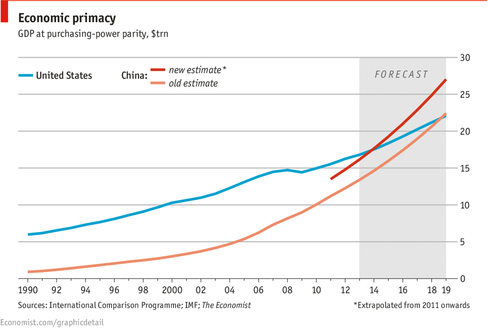
China is set to become World’s largest economy by years end, overtaking U.S.

UNTIL 1890 China was the world’s largest economy, before America surpassed it. By the end of 2014 China is on track to reclaim its crown. Comparing economic output is tricky: exchange rates get in the way. Simply converting GDP from renminbi to dollars at market rates may not reflect the true cost of living. Bread and beer may be cheaper in one country than another, for example. To account for these differences, economists make adjustments based on a comparable basket of goods and services across the globe, so-called purchasing-power parity (PPP). New data released on April 30th from the International Comparison Programme, a part of the UN, calculated the cost of living in 199 countries in 2011. On this basis, China’s PPP exchange rate is now higher than economists had previously estimated using data from the previous survey in 2005: a whopping 20% higher. So China, which had been forecast to overtake America in 2019 by the IMF, will be crowned the world’s pre-eminent country by the end of this year according to The Economist’s calculations. The American Century ends, and the Pacific Century begins.

China


US private sector jobs total 220,000 in April vs. 200,000 estimate: ADP

The number of jobs created in the U.S. private sector in April totaled 220,000. Economists had expected ADP’s national employment index to show the economy created 200,000 jobs in April, up from March’s 191,430 reading.

US first-quar​ter GDP up 0.1% vs. 1.2% estimate

U.S. first-quarter gross domestic product grew at a 0.1 percent annual rate. GDP had been expected to grow at a 1.2 percent annual rate, according to a Reuters survey of economists, pulling back from the fourth quarter’s 2.6 percent pace.

GDP


Payrolls jump in April as thaw hits jobs market    

Job creation accelerated in April as the U.S. economy added 288,000 new positions, while the unemployment rate plummeted to 6.3 percent amid a sharp drop in the workforce.   Read more

Factory orders rose for a second straight month in March, climbing 1.1 percent, suggesting strength in manufacturing and the broader economy at the end of the first quarter. Economists were predicting a gain of 1.5 percent, according to a Reuters estimate.


Sources: CNBC, Bloomberg, Reuters, Housingwire, KCM, MMG, The Economist

Waiting can cost you

We will continue to float, not lock Mortgage Rates, into the weekend, but very carefully as the Bond is near the higher end of the recent short term trading range. The technicals show some indecision after the recent rally.

Bonds rose by 12bp to end the week at 104.53 up 62bp for the week. The Dow fell by 140.19 points to 16,361.46, the S&P 500 lost 15.21 points to finish at 1,863.40, while the tech heavy Nasdaq fell by 72.77 points to end the week at 4,075.56. Oil was last seen at $100.61/barrel down $1.34 and down from $104.30 from the close on April 17. Next week’s economic calendar is packed full of a broad array of reports that will touch on key segments of the U.S. economy capped off by next Friday’s April Employment Report. April Non-farms expected at 210K.

Weekly Survey of Rates from the Mortgage Bankers Association –Wednesday April 23rd

The average contract interest rate for 30-year fixed-rate mortgages with conforming loan balances ($417,000 or less) increased to 4.49 percent from 4.47 percent, with points increasing to 0.50 from  0.32 (including the origination fee) for 80 percent loan-to-value ratio (LTV) loans.

The average contract interest rate for 30-year fixed-rate mortgages with jumbo loan balances (greater than $417,000) increased to 4.41 percent from 4.39 percent, with points increasing to 0.34 from 0.18 (including the origination fee) for 80 percent LTV loans.

The average contract interest rate for 15-year fixed-rate mortgages increased to 3.55 percent from 3.54 percent, with points increasing to 0.33 from 0.24 (including the origination fee) for 80 percent LTV loans.

Commercial Real Estate Lending

Commercial Mortgage backed Securities (CMBS)– The 10 Yr Swap rate moved lower to finish the week at 2.746%, up from last weeks 2.732%.

Housing News

No Deal: New Home Sales plunge in setback to housing recovery, except in the Northeast

Sales of new U.S. single-family homes tumbled to their lowest level in eight months in March, dealing a setback to the housing market recovery.

New Home Sales Chart


The Commerce Department said on Wednesday sales dropped 14.5 percent to a seasonally adjusted annual rate of 384,000 units, declining for a second consecutive month. February’s sales were revised up to a 449,000-unit pace from the previously reported 440,000-unit rate.

Economists polled by Reuters had forecast new home sales at a 450,000-unit pace last month. Compared to March last year, sales were down 13.3 percent, the largest decline since April 2011. Read more

Existing Home Sales fall in March amid hopes for end to downturn

U.S. home resales fell to their lowest level in more than 1-1/2 years in March, but there were signs a recent downward trend that has plagued the housing market may be drawing to an end.

The National Association of Realtors said on Tuesday home sales slipped 0.2 percent to an annual rate of 4.59 million units, the lowest level since July 2012. Read more

The cost of waiting to buy a home

For Millennials who are willing and able to purchase a home NOW… Here are a couple other ways to look at the cost of waiting.

Let’s say your 30 and your dream house costs $250,000 today, at 4.41% your monthly Mortgage Payment with Interest would be $1,253.38.  But you’re busy, you like your apartment, moving is such a hassle…You decide to wait till the end of next year to buy and all of a sudden, you’re 31, that same house is $270,000, at 5.7%. Your new payment per month is $1,567.08.

The difference in payment is $313.70 PER MONTH!  That’s like taking a $10 bill and tossing it out the window EVERY DAY!

Or you could look at it this way:

  • That’s your morning coffee everyday on the way to work (Average $2) with $12 left for lunch!
  • There goes Friday Sushi Night! ($80 x 4)
  • Stressed Out? How about 3 deep tissue massages with tip!
  • Need a new car? You could get a brand new $22,000 car for $313.00 per month.

Let’s look at that number annually! Over the course of your new mortgage at 5.7%, your annual additional cost would be $3,764.40!

Had your eye on a vacation in the Caribbean? How about a 2-week trip through Europe? Or maybe your new house could really use a deck for entertaining.  We could come up with 100’s of ways to spend $3,764, and we’re sure you could too!

Over the course of your 30 year loan, now at age 61, hopefully you are ready to retire soon, you would have spent an additional $112,932, all because when you were 30 you thought moving in 2014 was such a hassle or loved your apartment too much to leave yet.

Or maybe there wasn’t an agent out there who educated you on the true cost of waiting a year. Maybe they thought you wouldn’t be ready, but if they showed you that you could save $112,932, you’d at least listen to what they had to say.

They say hindsight is 20/20, we’d like to think that 30 years from now when you are 60, looking back, you would say to buy now…   KCM

RE/Max: March home sales build momentum for 2014  All 52 metro areas record increase in sales

March home sales increased over the previous month for the first time in 2014, rising 24.6% from February, in addition to all 52 metro areas surveyed reporting an increase in sales over February, according to the latest RE/MAX National Housing Report.

But despite the month-over-month rise, home sales were down 10.1% from year ago levels.  The median price of homes sold in March was 8.8% higher than the median price in March 2013. Low inventory continued to cause home prices to rise, especially in markets that have experienced an accelerated recovery.  In addition, March marked the 12th consecutive month with fewer inventory losses than the previous month.

“Clearly, unexpected winter storms resulted in a slow start for housing this year, but the strong rebound in March sales could build momentum for spring and summer,” said Margaret Kelly, RE/MAX CEO. “Many potential homebuyers who weren’t able to get out and tour homes in January and February may still enter the market and impact sales in the next few months,” Kelly added.

Economic News

A measure of the U.S. economy’s health rose in March for the third consecutive month, a sign of stronger growth after harsh winter weather caused the economy’s pace to slow.  The Conference Board says its index of leading indicators increased 0.8 percent in March after a 0.5 percent rise in February and modest 0.2 percent gain in January. It was the best showing since a 0.9 percent gain in November.

Economists polled by Reuters were expecting a gain of 0.7 percent in March.  Both hiring and consumer outlooks have improved, fueling much of the index’s improvement.

Conference Board economists say the gains last month point to “accelerated growth for the remainder of the spring and the summer,” although it remains to be seen whether employers continue to hire at their March and February pace of almost 200,000 workers a month.

U.S. Manufacturing activity expands in April, pace stalls

The U.S. manufacturing sector expanded in April though the rate of growth was slightly lower than expected as inventories fell, but factory output growth hit its fastest pace in three years, an industry report showed on Wednesday.

Financial data firm Markit said its preliminary or “flash” U.S. Manufacturing Purchasing Managers Index dipped to 55.4 in April from 55.5 in March. Economists polled by Reuters expected a reading of 56.0. Read more

U.S. orders for long-lasting factory goods rose by 2.6 percent in March. Economists had expected goods orders to rise by 2.0 percent, slower than the prior month’s 2.2 percent gain.

First-time claims for state unemployment benefits totaled 329,000 in the most recent week. Initial jobless claims had been expected to rise to 310,000, from the previous week’s 304,000 gain.

Consumer sentiment hits 84.1 in April, versus 83 estimate

Purchasing Managers Index hit 54.2 in April compared with March’s final reading of 55.3. (A reading above 50 indicates expansion in the sector.)


Sources: CNBC, Bloomberg, Reuters, Housingwire, MMG, KCM, AP.

Fed Vows Low Rates Post Recovery

We continue to recommend locking into Mortgage Rates in the short term, measured by days to a few weeks until Mortgage Bond Prices can find a bottom.
Mortgage  Bonds Prices have drifted lower all week and fell hard today due to better  than expected economic data. The 4% closed at 104.0 down 44bps. At 2pm ET,  Stock prices are mixed with equities closing at 4pm. The Bond markets  are now closed and all markets will be closed tomorrow in observance of  Good Friday.  Happy Easter.

Yellen: Fed will keep interest rates low even when economy recovers 

The length of time the Federal Reserve keeps its key interest rate near zero will depend on how far the U.S. economy remains from the central bank’s employment and inflation goals, and how long it will likely take to meet them, Fed Chair Janet Yellen said on Wednesday.

Yellen, in her second public speech as Fed chair, largely restated the central bank’s stance, stressing that it would respond to shifting economic conditions as it judges when to finally tighten monetary policy.

The central bank, frustrated with the slow U.S. recovery from recession, aims for maximum sustainable employment and a rise in inflation from just above 1 percent now to 2 percent. Read more

Weekly Survey of Rates from the Mortgage Bankers Association

The average contract interest rate for 30-year fixed-rate mortgages with conforming loan balances ($417,000 or less) decreased to 4.47 percent from 4.56 percent, with points decreasing to 0.32 from  0.33 (including the origination fee) for 80 percent loan-to-value ratio (LTV) loans.

The average contract interest rate for 30-year fixed-rate mortgages with jumbo loan balances (greater than $417,000) decreased to 4.39 percent from 4.49 percent, with points increasing to 0.18 from 0.14 (including the origination fee) for 80 percent LTV loans.

The average contract interest rate for 15-year fixed-rate mortgages decreased to 3.54 percent from 3.62 percent, with points decreasing to 0.24 from 0.31 (including the origination fee) for 80 percent LTV loans.

Commercial Real Estate Lending

Commercial Mortgage backed Securities (CMBS)– The 10 Yr Swap rate moved lower to finish the week at 2.732%, down from last weeks 2.798%.

Housing News

US housing starts climb in March, but trends point to slump

U.S. housing starts rose less than expected in March and building permits fell, pointing to underlying weakness in the housing market that could persist despite better weather.  The Commerce Department said on Wednesday groundbreaking increased 2.8 percent to a seasonally adjusted annual rate of 946,000.

February’s starts were revised to show a 1.9 percent rise rather than the previously reported 0.2 percent fall. Economists polled by Reuters had expected starts to rise to a 973,000-unit rate last month.   While a brutally cold winter weighed on home building in December and January, activity has also been hampered by shortages of building lots and skilled labor as well as rising prices for materials. Read more

Confidence among homebuilders in the market for new, single-family homes remained in a holding pattern in April, ticking up just one point to 47, according to the National Association of Home Builders/Wells Fargo Housing Market Index. The reading disappointed analysts who had expected it to rise to 49, according to a Reuters poll.

Benefits of Buying a Home Now

“Buying costs less than renting in all 100 large U.S. metros… Now, at a 30-year fixed rate of 4.5%, buying is 38% cheaper than renting nationally.” Trulia

“One thing seems certain: we are not likely to see average 30-year fixed mortgage rates return to the historic lows experienced in 2012…Yes, rates are higher than they were a year ago – and certainly higher than two years ago. But if you look at the averages over the last four decades, today’s rates remain historically low.”  Freddie Mac

Economic News

Consumer Prices on the Rise

The Labor Department reported on Tuesday that the April Consumer Price Index (CPI) on a year-over-year basis jumped by 1.5%, led higher by increased costs for food and shelter.  The numbers come after the hotter than expected Producer Price Index (PPI) last week.  Both the CPI and PPI measure inflation at the consumer and wholesale levels, respectively.  And yes it is just one month of hotter inflation, but the Fed will be closely watching the numbers for April for any signs of a trend.

Consumer Prices


U.S. industrial production rose 0.7 percent in March. Economists had expected industrial output to climb by 0.5 percent, compared with the prior month’s 0.6 percent gain.

U.S. retail sales increased 1.1 percent in March. Economists had expected sales to rise by 0.8 percent, up from the prior reading of 0.3 percent.

Consumer sentiment in the U.S. came in at 82.6. Economists had expected April’s advance reading of consumer sentiment to check in at 81.0, up slightly from March’s 80.0 reading.


Sources: CNBC, Bloomberg, Housingwire, Reuters, MMG


Rates Improve as Stocks Stumble

This week mortgage rates moved lower as the 4% Bond is nearing levels hit only twice this year. We will continue to float Mortgage Rates, not locking, but very cautiously. Rates are favorable, be careful as the technicals don’t give us any clear signs. Seeing this formation after an uptrend doesn’t mean you can sit back and take a vacation; for it does show indecision for Bonds.

Mortgage Bond prices rallied this week pushing Mortgage Rates lower, as Stocks were pressured on heavy selling as investors evaluated valuation levels against economic growth uncertainty. The major Stocks indexes had declines between 2.5% and 3.5%. This despite weekly initial jobless claims falling to near 7-yr lows. Today’s better than expected Consumer Sentiment capped Bond gains to a minimum, despite the plunge in Stocks. The 4% coupon closed at 104.59 up 6bp. Stocks fell as investors grow jittery and looked to secure profits. The Dow fell 143.47 points to 16,026.75, the S&P 500 lost 17.39 points to end at 1,815.69, while the tech heavy Nasdaq fell below 4,000 to end at 3,999.73 down 54.37 points. Oil was last seen at $103.37, closing near unchanged. Next week’s economic reports will touch on key sectors – housing, manufacturing, inflation and the job market (weekly claims).

U.S. Treasury Secretary Jack Lew told CNBC on Wednesday, by U.S. standards, we still have a lot of work to do to boost the economy. Read more

Fed minutes: Committee agreed 6.5% threshold was ‘outdated,’ vote to remove was unanimous

The members of the Federal Open Market Committee agreed unanimously in March that a 6.5 percent unemployment target for raising interest rates was ‘outdated’ and should be removed, according to Fed meeting minutes. Read more

Weekly Survey of Rates from the Mortgage Bankers Association

The average contract interest rate for 30-year fixed-rate mortgages with conforming loan balances ($417,000 or less) remained constant at 4.56 percent, with points increasing to 0.33 from 0.31 (including the origination fee) for 80 percent loan-to-value ratio (LTV) loans.

The average contract interest rate for 30-year fixed-rate mortgages with jumbo loan balances (greater than $417,000) increased to 4.49 percent from 4.46 percent, with points decreasing to 0.14 from 0.27 (including the origination fee) for 80 percent LTV loans.

The average contract interest rate for 15-year fixed-rate mortgages remained constant at 3.62 percent, with points increasing to 0.31 from 0.23 (including the origination fee) for 80 percent LTV loans.

Commercial Real Estate Lending

Commercial Mortgage backed Securities (CMBS)– The 10 Yr Swap rate moved lower to finish the week at 2.798%, down from last weeks 2.80%.

Housing News

Three Reasons to Sell Your Home this Spring –by KCM

Many sellers are still hesitant about putting their house up for sale. Where are prices headed? Where are interest rates headed? These are all valid questions. However, there are several reasons to sell your home sooner rather than later. Here are three of those reasons:

1. Demand is about to skyrocket

Most people realize that the housing market is hottest from April through June. The most serious buyers are well aware of this and, for that reason, come out in early spring in order to beat the heavy competition. We also have a pent-up demand as many buyers pushed off their home search this winter because of extreme weather. Sellers in markets where seasonal weather is never an issue must realize that buyers relocating to their region will increase dramatically this spring as these purchasers finally decide to escape the freezing temperatures of the winters in the north.

These buyers are ready, willing and able to buy…and are in the market right now!

2. There Is Less Competition – For Now

Housing supply always grows from the spring through the early summer. Also, there has been a growing desire for many homeowners to move as they were unable to sell over the last few years because of a negative equity situation. Homeowners have seen a return to positive equity as prices increased over the last eighteen months. Many of these homes will be coming to the market in the near future.

The choices buyers have will continue to increase over the next few months. Don’t wait until all the other potential sellers in your market put their homes up for sale.

3. There Will Never Be a Better Time to Move-Up

If you are moving up to a larger, more expensive home, consider doing it now. Prices are projected to appreciate by approximately 4% this year and 8% by the end of 2015. If you are moving to a higher priced home, it will wind-up costing you more in raw dollars (both in down payment and mortgage payment) if you wait. You can also lock-in your 30 year housing expense with an interest rate at about 4.5% right now. Freddie Mac projects rates to be 5.1% by this time next year and 5.7% by the fourth quarter of 2015.

Moving up to a new home will be less expensive this spring than later this year or next year.

Economic News

Happy days here again? Jobless claims tumble to near 7 year low

The number of Americans filing new claims for unemployment benefits fell sharply last week to the lowest level in almost seven years, which could bolster views of an acceleration in job growth after a cold winter dampened hiring.  Initial claims for state unemployment benefits dropped 32,000 to a seasonally adjusted 300,000 for the week ended April 5, the lowest level since May 2007, the Labor Department said on Thursday. Claims for the week ended March 29 were revised to show 6,000 more applications received than previously reported. Read more

Jobs Chart


U.S. wholesale inventories rose at a slower pace in February than in the prior month, increasing 0.5 percent after a revised 0.8 percent gain in January, which could support views that restocking will not help the economy in the first quarter.

U.S. consumer credit rose more than expected in February, likely reflecting a surge in demand for student and automobile loans.

The Bank of England left its key interest rate unchanged at 0.5 percent and made no changes to its asset purchase target.

Consumer sentiment in the U.S. came in at 82.6. Economists had expected April’s advance reading of consumer sentiment to check in at 81.0, up slightly from March’s 80.0 reading.


Sources: CNBC, Bloomberg, MMG, Housingwire, MBA, KCM

Home Prices up 12.2%. Yellen’s Damage Control.

A not too hot, not too cold March Jobs Report sent Stocks higher at the open, but closed lower while Bonds drifted higher throughout the session. Employers added 192K jobs last month, just below the 195K expected, while the Unemployment Rate remained steady at 6.7% with the previous 2 months revised higher by a total of 37K. The 4% coupon rose by 47bp to end at 104.16. As mentioned, Stocks declined – the Dow lost 159.84 points to 16,412.71, the S&P 500 declined by 23.68 points to 1,865.09, while the tech heavy Nasdaq plunged by 110.01 points or 2.6% to end the week at 4.127.72.  Oil was last seen at $101.17/barrel up 89 cents.

The current recommendation is to float, not lock into mortgage rates at this time.

Fed Chairman Yellen’s Damage Control

After last weeks sell off in stocks and bonds on the heels of Yellen’s first press conference, the Fed Chairwoman attempted to convince the markets that the Federal Reserve will continue to bolster the U.S. economy, Fed Chair Janet Yellen said on Monday, given the halting pace of the recovery and a still moribund job market.

In some ways, labor conditions are tougher now than in any other recession, Yellen said at a speech in Chicago. She added the Fed’s “extraordinary commitment,” in the form of massive bond-buying and ultra-low interest rates, is “still needed, and will be for some time.” read more

Weekly Survey of Rates from the Mortgage Bankers Association

The average contract interest rate for 30-year fixed-rate mortgages with conforming loan balances ($417,000 or less) was unchanged at 4.56 percent, with points increasing to 0.31 from 0.29 (including the origination fee) for 80 percent loan-to-value ratio (LTV) loans.

The average contract interest rate for 30-year fixed-rate mortgages with jumbo loan balances (greater than $417,000) increased to 4.46 percent from 4.45 percent, with points remaining constant at 0.27 (including the origination fee) for 80 percent LTV loans.

The average contract interest rate for 15-year fixed-rate mortgages was unchanged at 3.62 percent, with points decreasing to 0.23 from 0.24 (including the origination fee) for 80 percent LTV loans.

Commercial Real Estate Lending

Commercial Mortgage backed Securities (CMBS)– The 10 Yr Swap rate moved lower to finish the week at 2.798%, down from last weeks 2.80%.

Housing News

Home prices rose 12.2% from February 2013 to February 2014.

CoreLogic reported that home prices, including distressed  sales, rose by 12.2% year-over-year in February, which represents 24 months of  consecutive year-over-year increases.  From January to February, prices were up  0.8%.  Corelogic forecasted that prices could rise by 10.5% year-over-year in  March 2014 and 0.5% from February to March.  However, despite the rosy gains,  prices are still nearly 17% below their peak, which was set in April 2006.  The  big gains from 2013 are starting to cool and come back down to more normal  historical levels.
“As the spring home-buying season kicks off, house price appreciation continues to be strong.  Although prices should remain strong in the near term due to a short supply of homes on the market, price increases should moderate over the next year as home equity releases pent-up supply”. Dr. Mark Flemmming, Chief economist for Corelogic

core logic


Economic News

March manufacturing activity came in at 53.7. The Institute for Supply Management’s (ISM) had been expected to show a reading of 54.0 versus the prior month’s reading of 53.2.  Any reading above 50 indicates growth.

Jobs market bounces back as weather effects wane

Job creation returned to form in March as companies shook off some winter blues, albeit in a manner slightly below Wall Street expectations.

The economy added 192,000 new jobs for the month, while the unemployment rate held steady at 6.7 percent, according to the Bureau of Labor Statistics. The numbers were around consensus and less than indicative of a robust rebound, but still a sign that slowdowns in January and February likely were influenced at least somewhat by inclement conditions.

“It probably means the Fed just stays on steady, but it also means that everybody who said, ‘Oh, we finally turned the corner and we’re going to be booming like crazy,’ they’re going have to hold off for a few months,” former White House economist Austan Goolsbee told CNBC.

The number was slightly below February’s 197,000 gain, which was revised upward by 22,000. January’s total also moved higher in the revised count, from an anemic 129,000 to 144,000. Read more

Jobs chart


Orders for U.S. factory goods rose 1.6 percent in February. Economists had expected factory orders to rise by 1.2 percent, reversing the prior month’s 0.7 percent drop.


Sources: CNBC,Bloonberg, Reuters, MMG, Housingwire