
Good day for Mortgage Rates and Bonds but the gains stopped right at a ceiling of resistance at the 200-day MA. The 200-day MA is falling in value each day, if the Bond continues to cling to the 200-day MA, Mortgage rates will continue to move higher and worsen. With that said consider locking into rates at this time. Mortgage Bonds were able to bounce back today as the seesaw battle between Stocks and Bonds continued. Weak Existing Home Sales was a catalyst to push prices higher and rate lower as the Bond closed near resistance at the 200-day Moving Average at 104.19 up 16bp. The Dow finished at 16,103.30 down 29.93 points, the S&P 500 lost 3.53 points to 1,836.25 while the Nasdaq lost 4.13 points to end the week at 4,263.41. Oil was last seen at $102.26 down 49 cents.
Weekly Survey of Rates from the Mortgage Bankers Association
The average contract interest rate for 30-year fixed-rate mortgages with conforming loan balances ($417,000 or less) increased to 4.50 percent from 4.45 percent, with points decreasing to 0.26 from 0.34 (including the origination fee) for 80 percent loan-to-value ratio (LTV) loans.
The average contract interest rate for 30-year fixed-rate mortgages with jumbo loan balances (greater than $417,000) increased to 4.45 percent from 4.40 percent, with points decreasing to 0.11 from 0.14 (including the origination fee) for 80 percent LTV loans.
The average contract interest rate for 15-year fixed-rate mortgages increased to 3.55 percent from 3.49 percent, with points increasing to 0.33 from 0.25 (including the origination fee) for 80 percent LTV loans.
Housing News
Housing Starts in January declined by 16% from December, while Building Permits, a sign of future construction, fell by 5%.
Existing home sales down 5.1% in January, versus -3.5% estimate
Existing home sales fell more than expected in January and hit an 18 month-low as the combination of cold weather and a lack of housing stock sidelined potential buyers. The National Association of Realtors cites the disruptive and prolonged winter weather patterns, tight credit, limited inventory, higher prices and higher mortgage rates for the slip in Existing Home Sales. Read more
Home builder sentiment tumbled in February to 46 from 56, according to the National Association of Home Builders’ monthly sentiment index, the largest drop in the history of the survey. Fifty is the line between positive and negative sentiment.
Home Sales Up in 3 of 4 Regions
Some industry gurus are questioning whether the housing momentum we saw early in 2013 began to dissipate later in the year. The more dramatic have claimed the housing sector is still on shaky ground. Others have blamed the slowdown in sales on a lack of consumer confidence or rising interest rates.
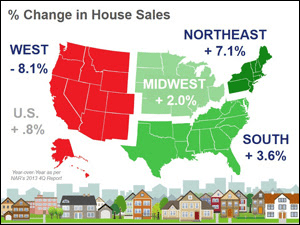
The National Association of Realtors (NAR) just released their 2013 4th Quarter Housing Report. The report revealed that home sales numbers barely outperformed (an .08% increase) those in the 4th quarter of 2012. We believe the leveling in home sales is directly attributable to a lack of salable listing inventory; specifically in the West.
Three of the four regions in the NAR report had an increase in sales: Northeast (+7.1%), Midwest (+2%) and South Regions (+3.6%). A big fall-off in sales occurred in the Western Region. The dramatic fall-off in the West (-8.1%) can be directly linked to a shortage of inventory in their hottest markets. If the decrease in sales was caused by an eroding of consumer confidence and/or rising interest rates, we believe each region would have seen similar decreases.
Economic News
Inflation at the wholesale level continues to be nearly non-existent.
A revamped U.S. government reading on producer prices rose by 0.2 percent in January. Economists had expected January producer prices to rise by 0.1 percent, the same rate as the prior month’s advance.
U.S. household debt posted its largest quarterly increase since before the recession, according to the New York Fed. Read more
A reading on New York State manufacturing activity came in at 4.48 in February. The Empire State manufacturing survey had been expected to show a reading of 9, down from 12.51 in January, according to a Reuters survey of economists.
Weekly claims for state unemployment benefits totaled 336,000. Economists had expected initial claims to dip by 4,000 to 339,000.
January’s consumer price index rose 0.1 percent, in line with expectations and against the previous month’s 0.3 percent gain.
Sources: CNBC, Bloomberg, KCM, MMG, Housingwire