
Mortgage Rates moved lower as Mortgage Bond prices rose sharply on Friday after the December Jobs report revealed that employers added just 74K new workers vs the 197K expected, which shifted investing dollars over into the safe haven of the Bond markets. The 4% coupon rose by 81bp to end the session at 103.72. Despite the weak jobs report, Stocks were able to close near unchanged levels – the Dow lost 7.71 points to end at 16,437.05, the Nasdaq was up 18.47 points to close at 4,174.66 while the S&P 500 Index was up 4.24 points to 1,842.37. Oil was last seen at $92.79/barrel up $1.23.
Weekly Survey of Rates from the Mortgage Bankers Association
For the week ending January 3rd. The average contract interest rate for 30-year fixed-rate mortgages with conforming loan balances ($417,000 or less) remained unchanged at 4.72 percent, with points unchanged at 0.28 (including the origination fee) for 80 percent loan-to-value ratio (LTV) loans.
The average contract interest rate for 30-year fixed-rate mortgages with jumbo loan balances (greater than $417,000) remained unchanged at 4.66 percent, with points decreasing to 0.12 from 0.27 (including the origination fee) for 80 percent LTV loans.
The average contract interest rate for 15-year fixed-rate mortgages increased to 3.77 percent from 3.73 percent, with points decreasing to 0.34 from 0.40 (including the origination fee) for 80 percent LTV loans.
Housing News
Predictions for 2014: Housing Supply Will Struggle to Keep Up with Demand
With a dramatic increase in demand for housing expected this year, it will be up to real estate professionals and builders to make sure there is the necessary inventory to satisfy this demand. This will be a challenge for much of 2014.
For a balanced real estate market, there should be approximately 5-6 months of inventory for sale (example: if 100 homes sold last month, we would need 500-600 homes available for sale). Nationally, we are just now hitting the five month level. As the spring selling season begins to heat up, a new wave of housing inventory would have to come to market to keep up with the increasing demand of buyers.
If we couple this seasonal increase with the other dynamics that will increase demand for housing in 2014, we believe that housing inventory could drop substantially. This, in our opinion, is the biggest threat to a full blown surge in sales this year.
Some experts have looked at the recent monthly decline in existing home sales nationally as evidence that a lack of consumer confidence or the increase in interest rates has buyers back up on the fence. However, a closer look at existing home sales reveals that sales remained unchanged in one of the four regions of the country (the Midwest) and actually increased in two other regions (the Northeast and the South). The only region that had a decrease in sales was the Western region (down over 10%).
If it was a matter of consumer confidence or mortgage rates, there would have been a similar decrease in sales throughout all four regions. The fall-off in sales in the West is directly attributable to a lack of salable inventory in the hottest markets in the region.
It is up to the builders and real estate agents in each community to make sure this doesn’t happen. KCM
Home Prices Continue to Rise
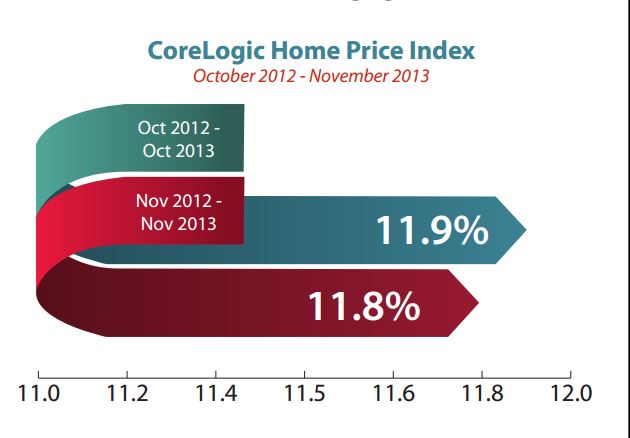
CoreLogic reports that its Home Price Index, which includes distressed sales, rose by 11.8% from November 2013 compared to November 2012. This marks the 21st consecutive month of year-over-year gains. However, the 11.8% is just below the 11.9% recorded from October 2012 to November 2012. CoreLogic said that the outlook for 2014 “is a bit less robust as regulatory complexities and tight credit can be expected to cool the housing market.”
Economic News
The U.S. private sector created 238,000 jobs in December, according to the ADP/Moody’s Analytics report. Economists had expected the survey to show the private sector created 200,000 positions, down slightly from the 215,000 initially reported the previous month. Read more
Weekly claims for state unemployment benefits totaled 330,000. Economists polled by Thomson Reuters had expected initial claims to come in at 340,000.
U.S. employers added far less jobs in December as the labor market continues to muddle along. The Labor Department reported that there were just 74,000 jobs created last month, well below the 197,000 expected and was the smallest increase since January of 2011. The Unemployment Rate fell to 6.7%, the lowest since the 6.5% recorded in October of 2008, which was partly due to 347,000 Americans leaving the workforce.
Sources: CNBC, Bloomberg, MMG, Housingwire, KCM